












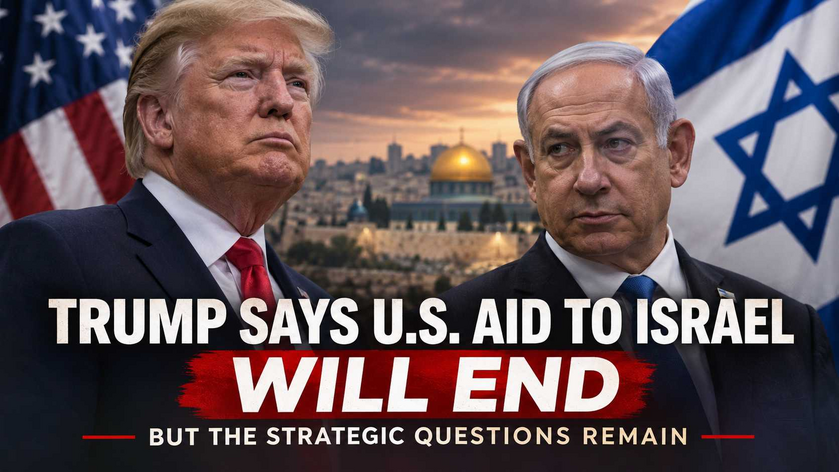
As Washington continues military operations against Iran, a surprising announcement about Israel raises questions about American commitments, regional security and the real value of foreign aid.
President Donald Trump has announced that the United States will stop providing approximately $4 billion in annual assistance to Israel at the end of this year, saying the country is prosperous enough to manage without American support. According to Trump, the decision was discussed with Israeli Prime Minister Benjamin Netanyahu, who reportedly suggested that Israel should begin moving away from its dependence on U.S. assistance.
The announcement deserves serious attention, not simply because Israel is one of America's most important allies, but because the financial relationship between the two countries is considerably more complicated than most people realize. There is also a significant question about how the proposed cutoff would work, given that the existing U.S.-Israel memorandum of understanding extends through 2028.
What America Gets in Return
When Americans hear that their government provides billions of dollars to another country, the understandable reaction is to ask why that money isn't being spent at home. I believe taxpayers have every right to demand accountability, but the more useful question is what the United States receives in exchange for that investment.
Much of the military assistance provided to Israel is used to purchase American-made defense equipment, supporting manufacturers, suppliers and jobs here in the United States. The arrangement also helps sustain a defense-industrial base that America depends upon for its own military readiness, meaning the benefits extend well beyond the equipment delivered to Israel.
There are strategic advantages that are harder to measure in dollars. Israel provides intelligence, military expertise and operational experience in a region where American interests are constantly threatened, while cooperation on missile defense and advanced aircraft has produced lessons valuable to both countries.
None of this means every dollar is automatically justified or that Israel should receive American assistance indefinitely. It does mean that ending the arrangement should be based on a careful assessment of what America stands to lose, rather than the assumption that eliminating foreign aid necessarily produces an equivalent financial benefit at home.
Iran Remains an Unfinished Conflict
The announcement comes as President Trump continues to describe the conflict with Iran as effectively over, despite acknowledging another American strike against Iranian air-defense infrastructure. During his recent remarks, Trump characterized the operation as relatively minor, while maintaining that the United States had already won the war.
That distinction is difficult to reconcile with the continuing military activity around the Strait of Hormuz. American forces remain engaged in operations intended to protect shipping and counter Iranian threats, and the existence of those missions suggests that the security situation remains unresolved.
Vice President JD Vance has expressed optimism about a possible negotiated settlement, emphasizing the need for verifiable assurances that Iran will not rebuild its nuclear program. Iranian officials, meanwhile, continue to issue warnings about further American military action, illustrating the considerable distance that may still separate the two sides.
I am concerned that Washington is allowing its public messaging to get ahead of the reality on the ground. A conflict does not become settled merely because political leaders prefer to describe it that way, particularly when military operations continue and the opposing government retains the ability to threaten regional security.
A Broader Question of American Leadership
The debate over Israel is part of a larger argument about America's responsibilities abroad. Similar questions arise when discussing assistance to Ukraine, where American equipment and support have contributed to Ukraine's defense while providing important information about the performance of modern weapons in combat.
I understand the frustration of Americans who are tired of expensive foreign commitments, especially when they are struggling with rising prices and uncertainty at home. But withdrawing from international partnerships also carries costs, and those costs must be weighed against any immediate savings.
Supporting an ally does not require agreeing with every decision its government makes, just as supporting an American president does not mean remaining silent when his policies deserve scrutiny. My responsibility as a journalist is to examine what is happening, question the claims being made and tell you what I believe the evidence supports, regardless of which political party is in power.
For now, Trump's announcement raises more questions than it answers. Until the administration explains how the proposed cutoff fits with the existing agreement and what arrangements would replace it, Americans should be cautious about treating the end of military assistance to Israel as a settled decision.