




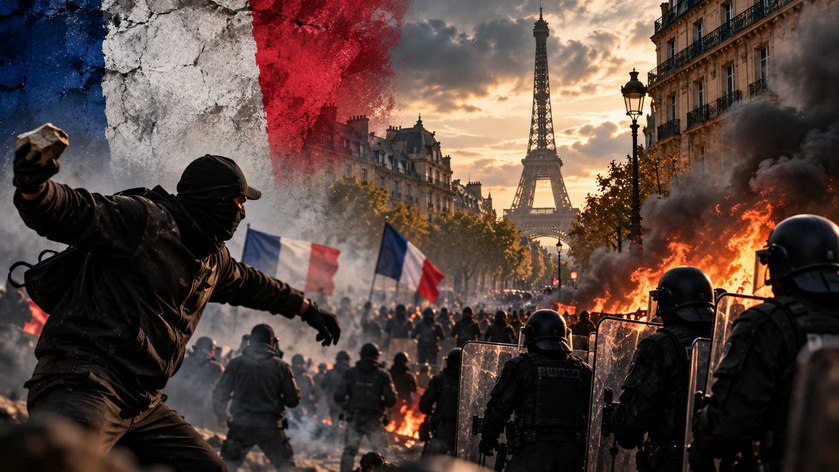
As France struggles to contain violent demonstrations, questions are emerging about the organizations supporting protest movements, their international connections, and what the unrest could mean for the United States.
France is experiencing another period of serious civil unrest, with violent demonstrations, damaged businesses and attacks on public buildings prompting authorities to impose curfews in an effort to restore order. But beyond the immediate destruction, there is a larger question that deserves attention: Are these demonstrations simply spontaneous expressions of public frustration, or are organized political networks helping turn legitimate grievances into something far more destructive?
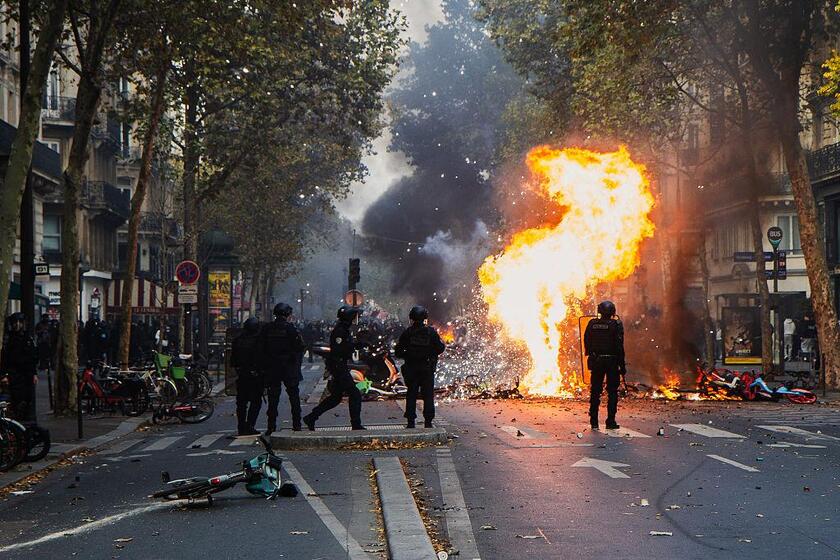
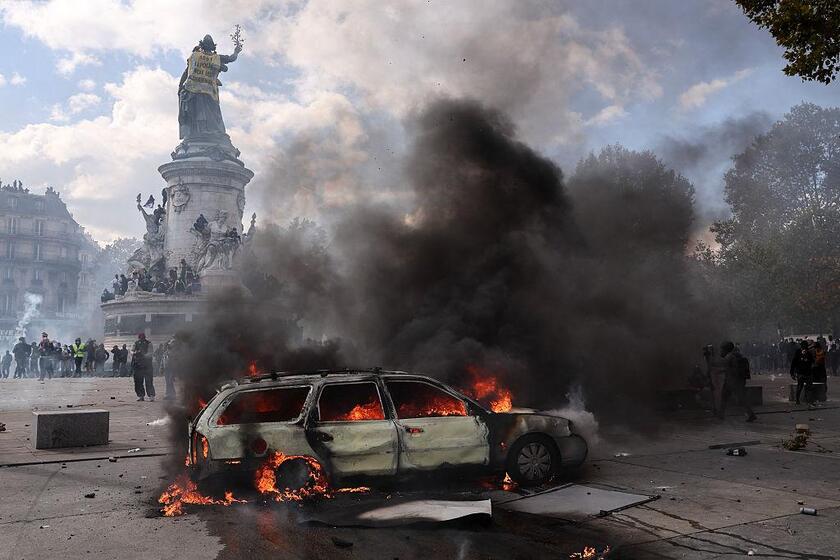
Demonstrations over rising living costs and public services escalated into clashes, fires and looting across France on October 17, 2026. Hundreds of thousands participated in the nationwide protests, while authorities reported extensive arrests and damage in several cities.
Photo credit: Stéphanie Lecocq / Reuters
That was the central issue I examined during my latest Hot Zone broadcast. After years of reporting from demonstrations and riots around the world, I've learned that the people filling the streets are not always the only ones shaping what happens there. Political organizations, advocacy networks and wealthy donors can play an important role in organizing demonstrations, distributing materials and promoting particular messages. The challenge is determining where legitimate political organizing ends and where unlawful activity begins. Those distinctions matter, especially when allegations involve foreign influence, political extremism and the possibility of coordinated violence.
I'm preparing to travel to France to investigate the situation firsthand, speak with people on the ground and examine what is actually happening beyond the images circulating online.
France's Unrest Raises Questions About Public Order
According to reports discussed during the broadcast, French authorities have imposed overnight curfews in several areas, with restrictions reportedly running from 11 p.m. until 6 a.m. Some local officials have also introduced additional measures aimed at younger demonstrators.
More than 2,400 arrests and damage to over 2,000 businesses were reported during the unrest, although those figures require confirmation from official French sources.
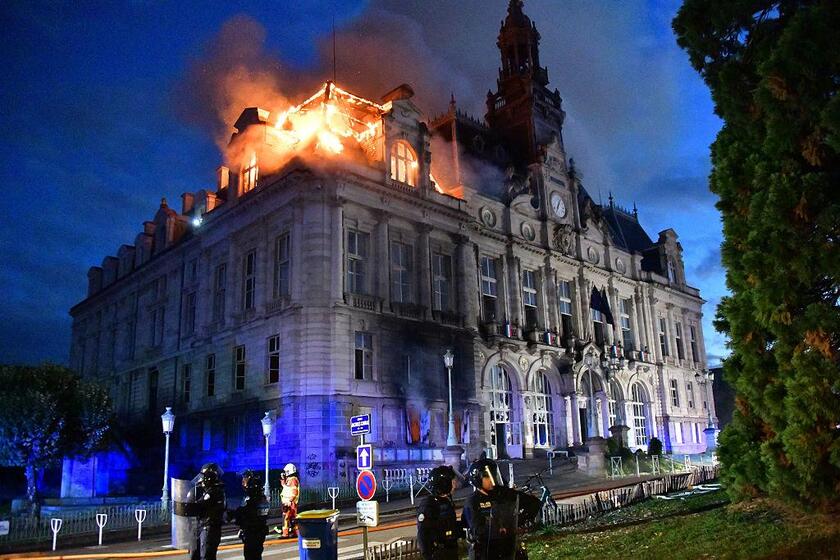
One of the most disturbing incidents involved a fire at a historic municipal building in Limoges. The structure, described as more than 140 years old, suffered extensive damage. I intend to visit the area during my reporting trip because the destruction of a building like that represents much more than a financial loss.
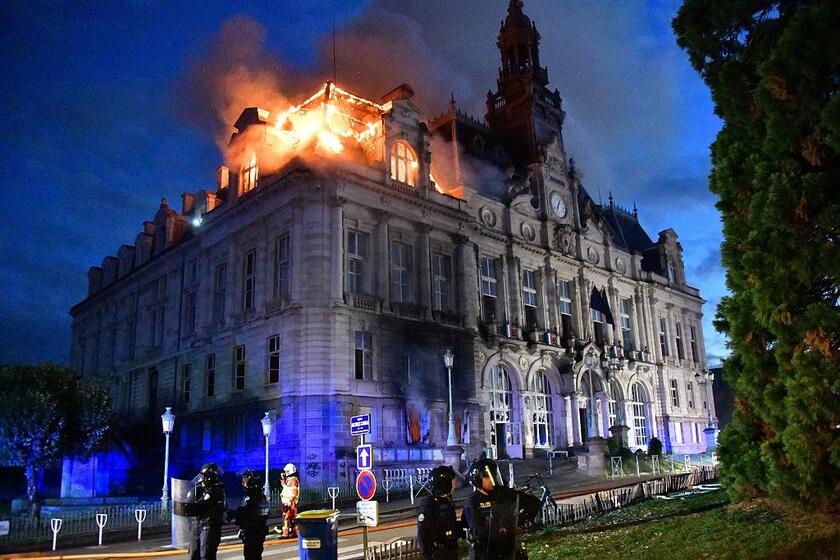
Flames engulf the historic town hall in Limoges, France, on October 17, 2026, during nationwide unrest. The nineteenth-century building suffered extensive damage, including the collapse of sections of its roof.
Photo credit: Lucas Destrem / Reuters
Historic buildings preserve the identity of communities. They reflect generations of craftsmanship, civic investment and cultural heritage that cannot easily be replaced.
There have also been disturbing allegations that some businesses were targeted because of their Jewish ownership. I want to be particularly careful about that claim because I have not independently confirmed it. If investigators establish that Jewish-owned businesses were deliberately identified and attacked, that would raise serious concerns about antisemitic violence, but it would be irresponsible to present the allegation as established fact before the evidence is available.
Meanwhile, Marine Le Pen has emerged as one of the most prominent political voices responding to the unrest.
In remarks featured during the broadcast, she condemned the destruction of public buildings, attacks on police officers and looting of businesses while calling for greater accountability. "Violence is not an opinion. Destruction is not expression. And chaos is no plan for France," she declared.
Le Pen also proposed making individuals convicted of damaging property financially responsible for the destruction they cause. I believe that principle deserves serious consideration. People who deliberately destroy businesses, vehicles and public property should face meaningful legal consequences, including restitution where appropriate. Peaceful protest is a fundamental right, but it does not provide immunity for criminal conduct.
The Organizations Behind the Demonstrations
One of the most revealing parts of my investigation involved examining the organizations associated with demonstrations in France.
During the broadcast, I discussed reporting that identified approximately 54 organizations participating in, supporting or promoting protest activity. The groups represented a broad range of political interests, including student organizations, labor unions, socialist movements, environmental campaigns, Palestinian solidarity organizations and anti-fascist networks.
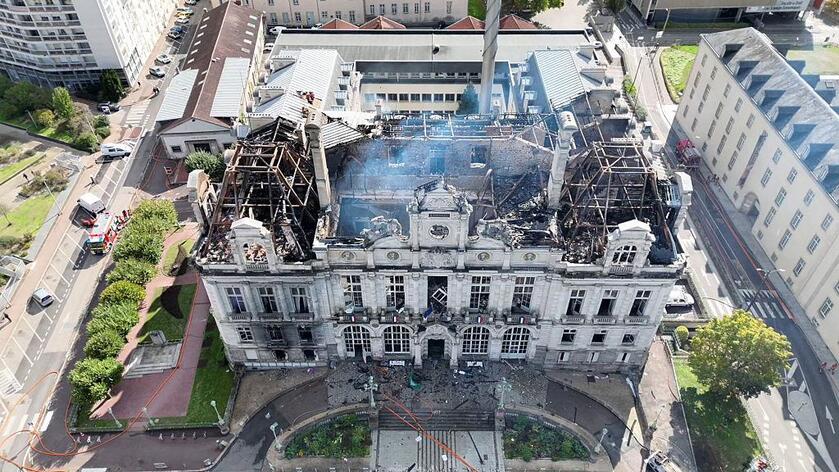
Debris covers the interior of Limoges town hall following a fire during the October 17 demonstrations. The damage to the protected historic building has raised concerns about the loss of an important part of the city's architectural heritage.
Photo credit: Ville de Limoges, via The Connexion
The involvement of these organizations does not automatically mean they are coordinating violence. Political organizations routinely participate in demonstrations, and peaceful advocacy is not evidence of criminal wrongdoing. Nevertheless, the overlap between different movements raises legitimate questions about how protests are organized, how messages spread and whether particular groups are attempting to redirect public anger toward broader ideological objectives. I encountered similar patterns while covering demonstrations in the United States.
During the first Trump administration, I spent approximately two years traveling around the country reporting on protests involving gun policy, racial justice, abortion, immigration and other contentious political issues. I began recognizing some of the same individuals at demonstrations thousands of miles apart. People I had encountered in Portland would later appear at events in Washington, D.C., sometimes carrying similar signs and repeating nearly identical political messages.
That experience convinced me that at least some protest movements involve experienced organizers who travel between events and maintain connections with larger advocacy networks. Of course, recognizing the same activists at multiple demonstrations does not establish that they are being paid to commit crimes. But it does illustrate why journalists should examine the organizational structures behind major protest movements rather than treating every demonstration as an entirely isolated event.
Following the Money: Neville Roy Singham and the Socialist Movement
One individual who deserves closer scrutiny is Neville Roy Singham, an American technology entrepreneur who sold his software consulting company and subsequently became involved in funding left-wing political and media organizations. Singham has attracted attention because of his financial relationships with organizations that promote socialist causes and his connections to China, where he has lived and maintained business and political relationships.
During the broadcast, I examined the Party for Socialism and Liberation, an American socialist political organization whose messaging has appeared at demonstrations in different locations. One sign caught my attention because I recognized it from protests I had covered years earlier in Washington.
Its message read:
"Trump is a symptom. Capitalism is the disease. Socialism is the cure."
The same slogan appeared in material associated with demonstrations discussed during the broadcast. For me, that illustrated the continuity of political messaging across different countries and protest movements.
Singham's relationships with organizations associated with socialist activism have been the subject of public scrutiny. However, the precise funding arrangements between individual donors, nonprofit organizations and political groups must be established through financial records rather than assumptions.
I am particularly concerned about the possibility that foreign governments could exploit these networks to influence public opinion or deepen political divisions in Western countries. China has an obvious strategic interest in weakening American influence and promoting narratives favorable to the Chinese Communist Party. But that strategic interest alone does not prove that Beijing is directing a particular protest, financing criminal activity or controlling the organizations involved.
During the broadcast, I offered my opinion that some of the money supporting these networks could ultimately be connected to Chinese government interests. I also made clear that I had not independently corroborated that conclusion. That is precisely why further investigation is necessary. The important questions concern where the money originates, how it moves between organizations, whether foreign officials exercise influence over its distribution and whether any funds are used to facilitate unlawful conduct. Those are questions that should be answered through evidence, not political assumptions.
From France to Italy and Ireland
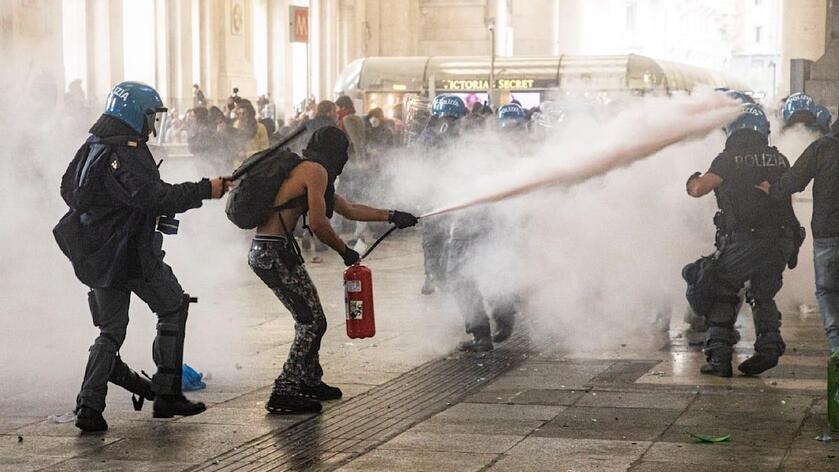
The demonstrations discussed during the broadcast were not limited to France. I also examined footage from Florence, Italy, and Ireland, where protesters displayed political symbols and Palestinian flags. The appearance of similar symbols across demonstrations involving different local grievances caught my attention because it suggests that some activists see these issues as connected parts of a larger political struggle.
That does not mean every person carrying a Palestinian flag supports the same political organizations, much less violent extremism. The symbols used at demonstrations can reflect solidarity, ideological affiliation or broader opposition to government policies. However, the participation of international activist networks in multiple movements is a legitimate subject for investigation. Some organizations view conflicts in the Middle East, economic inequality, environmental policy and opposition to Western governments through a shared ideological framework. That can create alliances between groups that otherwise disagree on major political or social questions.
The resulting coalitions may be politically influential, but their existence does not establish that their participants share responsibility for violent acts committed by particular individuals. What matters is whether organizers are encouraging peaceful political participation or deliberately facilitating intimidation, vandalism and attacks. Governments should make that distinction carefully, protecting the rights of lawful demonstrators while holding those responsible for violence accountable.
How China, Russia and Iran Fit Into the Larger Picture
The unrest in Europe also raises a broader geopolitical question about the interests of governments that oppose American and European influence.
China, Russia and Iran have developed increasingly important relationships in recent years, particularly as Moscow has sought additional economic and diplomatic support during its war against Ukraine. During the broadcast, I discussed Russian Foreign Minister Sergey Lavrov's reported visit to Tehran and his remarks concerning Russia's relationship with Iran.
Lavrov also claimed that Russia had not intentionally targeted Ukrainian civilian infrastructure except where facilities directly supported Ukrainian military operations. That assertion is difficult to reconcile with what I have personally witnessed in Ukraine.
I've walked through the ruins of apartment buildings destroyed by Russian attacks. I've seen residential neighborhoods where families were killed and where the destruction bore no obvious relationship to a legitimate military target. The human consequences of Russia's invasion cannot be explained away through diplomatic statements.
Reports of growing Russian support for Iran are also significant because Tehran remains deeply involved in regional confrontations affecting Israel and American interests. Russia and Iran have different political systems and strategic priorities, but both have reasons to challenge Western influence. China, meanwhile, benefits from economic and diplomatic relationships with both governments.
I have argued that these increasingly connected conflicts may represent the early stages of a much broader international confrontation. That is my strategic assessment, not a declaration that a formal world war has begun.
The danger is that regional conflicts, economic competition, information campaigns and military partnerships could increasingly reinforce one another, making it harder for Western governments to respond to any single crisis without confronting several others.
Trump's Ukraine Statements Raise Serious Concerns
One of the most troubling developments discussed during the broadcast involved President Donald Trump's latest comments about Ukrainian President Volodymyr Zelenskyy.
After Zelenskyy reportedly suggested that Trump was on the wrong side of history regarding the war, Trump responded by criticizing the Ukrainian president and arguing that he should have accepted an earlier agreement. Trump also claimed that Ukraine had given the United States nothing in return for American assistance.
I strongly disagree with that assessment. Ukraine has provided the United States and its allies with an extraordinary opportunity to understand how modern warfare is changing. Before Russia's full-scale invasion, Western military planning remained heavily focused on conventional weapons systems, including tanks, armored vehicles and expensive platforms developed for earlier generations of warfare. Ukraine has demonstrated the importance of inexpensive drones, electronic warfare, rapid battlefield adaptation and decentralized technological innovation. The lessons emerging from that conflict are already influencing military planning around the world.
American defense planners have gained valuable information about how Western equipment performs against Russian systems, how drones can disrupt conventional formations and how relatively inexpensive technology can impose enormous costs on a much larger military.
Those lessons have strategic value that extends far beyond the financial assistance Washington has provided. Ukraine has also imposed substantial losses on Russia's armed forces, reducing Moscow's capacity to threaten other countries. That does not mean the United States should provide unlimited assistance without oversight. It means that American support should be evaluated against the security benefits and strategic consequences involved. When Trump suggests that Ukraine has contributed nothing, he overlooks some of the most important military lessons of the twenty-first century.
Russia's Military Buildup Near NATO
Another issue receiving increasing attention is Russia's reported movement of military equipment into storage facilities near NATO territory.
During the broadcast, I examined reports describing tanks, infantry fighting vehicles, armored personnel carriers and artillery being positioned or refurbished in regions relatively close to Finland and the Baltic states. The reports included references to equipment in Karelia and the Kostroma region, although the specific deployments and their intended purpose require independent verification. The concern is understandable. Russia has suffered significant equipment losses in Ukraine, where drones have made traditional armored operations increasingly dangerous. At the same time, NATO governments are reassessing their own readiness for a possible confrontation with Moscow. I raised the possibility that Russia could be positioning certain conventional systems for contingencies involving NATO countries whose forces have not yet adapted as extensively to drone warfare. That remains an interpretation rather than a confirmed Russian operational plan.
Nevertheless, European governments would be foolish to ignore the lessons of Ukraine.
The next major war may be decided as much by electronic warfare, unmanned systems and the speed of technological adaptation as by the number of tanks and artillery pieces a country possesses.
NATO must prepare accordingly.
The Danger of Political Tribalism
One question from viewers during the broadcast captured a problem that extends far beyond Europe. A viewer explained that he struggled with the Russia-Ukraine conflict partly because American Democrats supported Ukraine, making him reluctant to support the same position. I understand how political polarization produces that reaction, but I believe it is a dangerous way to evaluate international events.
We cannot decide whether a country is right or wrong simply by looking at which American political party supports it. Russia invaded Ukraine. Ukraine did not invade Russia. That distinction matters. My perspective begins with a moral assessment of the conflict, informed by my Christian faith and my experience reporting from the region. It does not require me to agree with every decision made by Ukraine's government or to support every policy proposed by American politicians. It requires me to recognize that an independent nation has the right to defend itself against foreign aggression. The same principle should guide our response to political extremism at home. Violence committed by far-left organizations is wrong, but violence committed by far-right extremists is equally wrong. I've reported from demonstrations involving neo-Nazis and other radical movements, and I have seen the danger posed by extremism from different political directions. A free society must defend peaceful political expression while rejecting intimidation, vandalism and attacks on innocent people, regardless of who commits them.
Why I'm Going to France
The events unfolding in France deserve more than commentary based on social media videos and competing political narratives. I intend to travel there, examine the damage, interview people affected by the unrest and investigate the claims surrounding the organizations involved. Some of the allegations circulating online are serious, particularly those involving antisemitic targeting, foreign financial influence and the possible coordination of violent demonstrations.
Those claims must be investigated carefully rather than repeated without evidence. The broader challenge is already clear. Western societies are facing increasingly complex security threats in which domestic political instability, international ideological movements and competition between major powers can overlap. Governments must be prepared to enforce the law without undermining civil liberties, and journalists must be willing to investigate uncomfortable questions without allowing political preferences to substitute for facts. The people whose businesses have been destroyed and whose communities have been damaged deserve accountability. The public also deserves accurate information about who is organizing demonstrations, where the money comes from and whether foreign interests are attempting to exploit political divisions. That is what I intend to investigate when I arrive in France. Because when a city is burning, the most important question is not simply who is standing in the street. It is what caused the unrest, who is exploiting it and what can be done to prevent the destruction from happening again.