Chuck Holton
Politics • Culture • News
Iran Is Begging for Help — And the Clock Is Running Out
January 15, 2026
post photo preview

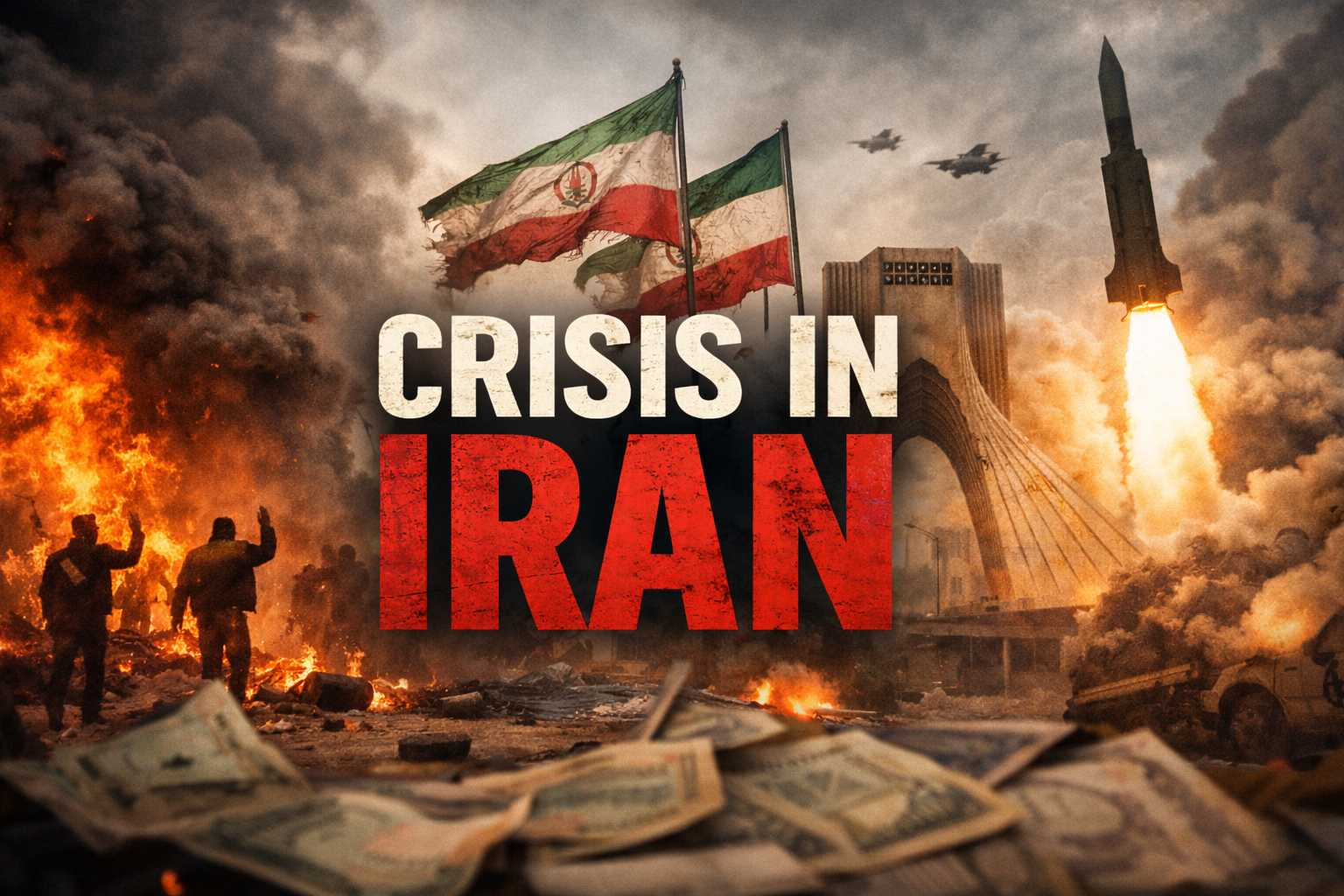
I’m coming to you tonight from Panama, and that probably sounds like a long way from Tehran. But in a world where missiles can cross borders in minutes and regimes can fall in days, geography doesn’t always determine relevance. The story unfolding in Iran right now is one of those moments that demands attention, because it isn’t merely a protest movement or a political quarrel inside a faraway country. It is a government turning its weapons inward, and it is a population pleading—openly, desperately—for outside help before the slaughter becomes irreversible.

For nearly three weeks, protests have continued inside Iran. The problem is not that people have stopped resisting; it’s that they are being crushed with a level of violence that would stagger even seasoned war reporters. What we are hearing from reputable sources, including the Institute for the Study of War, is that protest activity has dropped sharply in recent days. That decline is not a sign that the people have lost their will. It is a sign that the regime has decided to make an example out of dissent, and it is doing so through mass killings and terror tactics designed to empty the streets.

There are estimates circulating that suggest somewhere between ten and twenty thousand protesters have already been killed. Those numbers are difficult to confirm in real time—because the regime has aggressively restricted information leaving the country—but the pattern is consistent across multiple sources and across what we can see and hear in the footage that does emerge. In one clip, gunfire crackles in the background as young people stand their ground, unarmed, refusing to be scattered. In another, a man who escaped into Turkey breaks down, crying, and says plainly that the regime is “killing everyone,” and that nothing will change unless help comes from outside Iran. His words are not rhetorical. They are survival math.

That is the part many outsiders still fail to grasp: the people do not have weapons. The regime does. When you hear sustained gunfire in Tehran, you are not hearing a revolution fighting back. You are hearing state forces firing into crowds, and you are hearing a government that believes it can solve political weakness with kinetic force. It is the kind of violence that makes every claim of “reform” or “moderation” sound absurd, because a regime that shoots its own civilians as policy is not a regime that can be negotiated into decency.

And then there is the silence—the strange, selective silence—from the very institutions and personalities that claim to exist for moments like this. Where is the UN? Where is the International Criminal Court? Where are the activists who have made careers out of accusing others of genocide? Where are the street protests in Western capitals when Iranian teenagers are reportedly being murdered in their homes? You don’t have to like my tone to understand my point: the outrage appears whenever it is politically convenient, and it disappears whenever the victims do not serve the right narrative.


Only for Supporters
To read the rest of this article and access other paid content, you must be a supporter
11
What else you may like…
Videos
Podcasts
Posts
Articles
Update From Croatia

From yesterday*

I appreciate all of you supporting the hot zone. Thank you for being here.

How do you think this is all going to end?

00:03:39
Ukraine Safeguarding its Troops with Technology

If you have wondered why Russia is losing so many men and Ukraine is not, this will help explain it. Russia is sending men into the front lines where they are killed by drone operators from Ukraine who are hundreds of miles away from the front lines.

00:02:17
Live Call Recording: April 25, 2026

Thank you all for joining us this month on our Live call. I love getting to see your faces and have real conversations with you all.

What was your favorite moment or topic from this call?

01:25:31
Episode 622 - Field Producer Dennis Azato and Chuck Reminisce

My erstwhile field producer and cameraman Dennis Azato has accompanied me on ten years of adventures across the globe. Today he joins me in Ukraine and we spend some time remembering our many trips together.

Episode 622 - Field Producer Dennis Azato and Chuck Reminisce

At the beginning of creation, there was darkness and disorder, but when God first spoke, Light shone into the darkness (Genesis 1:1-5), not physical light because the stars (etc.) were made on the fourth day (Genesis 1:14-19), but the Light of the revelation of God's glory, truth and goodness. Likewise, before Christ illuminated our lives, our hearts were in darkness, but when we heard and believed the Gospel, Jesus shone into our hearts the revelation of the knowledge of God's glory (2 Corinthians 4:6). Instantly and permanently changing our identities into children of Light (Ephesians 5:8-9), new creations in Christ (2 Corinthians 5:17), born again spiritually in the likeness of God (1 John 3:9). Now, we are not of the darkness nor are we of the night, but of the Day and of the true Light (1 Thessalonians 5:4-5), according to God's grace in Christ!

June 11, 2026

I read just now that YET AGAIN our president has cancelled the attacks in Iran because they want to "make a deal." G-d help us! At this point I don't know what to believe about President Trump. I find this behavior more and more disturbing by the day. Am I wrong? What am I missing? We are praying daily for wisdom and knowledge for him so I feel I must be missing something but it doesn't feel like that is the case.

“@wendybellradio Wendy Bell Radio on Locals, Jun 10, 2026:
“Pfizer Adverse Events Internal
Report, Here are all the Adverse Event they didnt want you to know about.” AND “DISQUALIFYING
Democrats get behind all the wrong people.
They embrace thugs and goons who do horrible things - who should be
DISQUALIFIED from society.
Luigi Mangione.
George Floyd.
James Talarico.
Karmelo Anthony.
Tren de Aragua.
Even Xavier Becerra.
Becerra oversaw the loss of 450,000 frightened children who crossed our border under Joe Biden - who made that deadly journey ALONE - with no family to protect them.
Becerra let that happen and scolded his staff for processing those children tast enough.
And democrats want him to be California's next governor?
Now they love Graham Platner.
Shouldn't a guy with as disturbing a back storv as Platner's be…”
https://wendybellradio.locals.com/upost/7991379/pfizer-adverse-events-internal-report
https://wendybellradio.locals.com/upost/7996113/disqualifying

post photo preview
Early Access Content - Supporters Only
IT'S TREASON THEN!

Candace Owens says she traveled to Russia for a family vacation, but there's a lot more to this story than sightseeing and church visits. In this video, I break down her appearance at a major Kremlin-linked event, the reality of religious freedom in Russia, the role of the Russian Orthodox Church in supporting Putin's war effort, and why Moscow benefits when influential Americans promote Russia as a model Christian society. We'll separate fact from narrative and look at what is really happening behind the headlines.

Only for Supporters
To read the rest of this article and access other paid content, you must be a supporter
Read full Article
post photo preview
Trump Pushes Massive Middle East Deal

For months, the central question surrounding Iran has been whether the regime can withstand the economic and military pressure being applied by the United States and its allies.

This week, a different question emerged.

What if Iran is already getting what it wants?

President Trump continues to insist that Iran cannot be allowed to obtain a nuclear weapon. During a rare televised cabinet meeting, he pointed to Iran's economic collapse, soaring inflation, and internal instability as evidence that Tehran has little choice but to negotiate. According to Trump, Iran's leadership is feeling the pressure.

The problem is that pressure alone does not guarantee results.

Recent reports out of Iran claimed that negotiators were discussing a framework that would effectively grant Tehran greater influence over the Strait of Hormuz while postponing any serious discussion of its nuclear program. The White House has since dismissed those reports as false, but the episode exposed a growing concern among regional observers.

Negotiations appear to be moving slowly, while events on the ground continue moving in Iran's favor.

The Strait of Hormuz Changes Everything

At the center of the debate is the Strait of Hormuz.

Roughly one-fifth of the world's oil supply normally passes through this narrow waterway. Whoever controls access to it holds significant leverage over global energy markets.

Before the conflict escalated, Iran did not possess the level of influence over shipping traffic that it does today. Now, according to several military analysts, Tehran has demonstrated an ability to disrupt one of the world's most important commercial chokepoints.

That reality is shaping every negotiation.

Retired General Jack Keane warned that Iran views control of the Strait as a strategic prize and has little incentive to surrender that leverage voluntarily. Gulf Arab states are watching closely. Their economies depend on stable energy exports, and many are increasingly uncertain about how the current negotiations will end.

The longer uncertainty continues, the more regional governments may begin making their own accommodations with Tehran.

Military Force Has Limits

Former CENTCOM Commander General Joseph Votel offered another important perspective.

Military action can weaken Iran. It can destroy infrastructure, degrade capabilities, and impose costs. But military force alone is unlikely to produce a lasting solution.

Only for Supporters
To read the rest of this article and access other paid content, you must be a supporter
Read full Article
post photo preview
America Is Hunting Terrorists Again — And Iran May Be Next

While most Americans were grilling burgers, watching baseball, or trying not to think about geopolitics for five minutes, the United States quietly carried out a major counterterrorism operation in Nigeria—and at the same time, all signs point to President Trump preparing for another possible strike on Iran. Those two stories may seem unrelated.

They’re not. They tell us a lot about where American foreign policy is headed, how terrorism has evolved, and why the Middle East may be far from finished exploding.

If you missed the LIVE, you can watch it HERE

The U.S. Just Took Out One of the World’s Top Terror Leaders

President Trump announced that U.S. special operations forces, working alongside Nigerian forces, eliminated Abu Bal al-Minuki—the number two global leader of ISIS.

Or as I jokingly call them on YouTube so I don’t get demonetized: the “Black Pajama Boys.”

Now before you shrug this off as another headline from some faraway place most Americans can’t find on a map, understand what this means. ISIS never really disappeared. We destroyed their caliphate during the first Trump administration. We crushed their territorial control in Syria and Iraq. But the organization itself survived. The brand survived. And now the center of gravity for ISIS activity has shifted into Africa.

That’s where the war is.

Africa Is Becoming the New Terror Front

Most Americans still think of terrorism through the lens of Iraq and Afghanistan. That’s outdated thinking. Today, the majority of ISIS activity is concentrated across parts of Africa—especially Nigeria and the surrounding region. And the violence there is horrific. Last year alone, more than 3,600 Christians were murdered in Nigeria.

Three thousand six hundred people slaughtered largely because of their faith. Some of that violence comes from ISIS-linked groups. Much of it comes from radicalized Fulani militants who attack Christian villages, burn homes, seize farmland, and massacre civilians. I’ve been to Nigeria. I’ve seen the fear people live under there. And while the world’s media obsesses over American politics 24 hours a day, entire Christian communities are being erased in parts of Africa with barely a mention.

Why America Should Care

There’s a growing mindset in America that says:
“America First means America Only.”

I disagree. If we have the ability to stop terrorists before they spread globally, we should do it. Not because we’re the world’s babysitter. But because history shows that when terrorists are allowed to build safe havens overseas, eventually Americans die too. That’s not theory. That’s exactly what happened before 9/11. And ISIS has adapted. Instead of focusing solely on controlling territory, they’re now investing heavily in online radicalization.

They recruit lone wolves.
They inspire attacks remotely.
They spread propaganda globally.

That means the battlefield isn’t just Nigeria anymore. It’s your phone.

Iran Is Playing Games — And Trump Knows It

At the same time all this is happening, the Iran situation is getting more dangerous by the day. President Trump openly admitted that negotiations with Iran keep collapsing because Tehran repeatedly agrees to terms… and then pretends the conversation never happened. That’s because Iran was never negotiating in good faith to begin with. They’re stalling. Trying to preserve their nuclear capability while avoiding another American strike.

And meanwhile, the regime is preparing its own population for possible war. Iran reportedly sent text messages asking citizens whether they’d be willing to “martyr themselves for the regime.” Think about how insane that is. At the same time, Iranian state television has literally been airing AK-47 training sessions for civilians—although judging by the footage, some of these guys shouldn’t be trusted with a Nerf gun. One instructor accidentally fired a round through the ceiling of the studio during a live demonstration.

Funny? Sure. Also revealing. Because it tells you the regime is nervous.

The Strait of Hormuz Is the Real Red Line

A lot of people think this conflict is mainly about nuclear weapons. It’s not. The real issue is control of the Strait of Hormuz—the narrow waterway through which a huge percentage of the world’s oil flows. Iran wants control over it. The rest of the world cannot allow that. That’s why the U.S. still has major naval forces positioned in the region right now, even after the ceasefire. And according to multiple reports, additional military strikes could happen as soon as this week.

Here’s the Bigger Picture

What we’re watching right now is a transition. America appears to be moving back toward aggressive counterterrorism operations overseas while simultaneously preparing for the possibility of a larger regional conflict with Iran. And unlike the endless nation-building experiments of the past, these operations are increasingly:

  • precision-based,
  • intelligence-driven,
  • drone-supported,
  • and focused on eliminating threats before they metastasize.

That’s the future of warfare. But it also means the world is becoming more unstable—not less.

Final Thought

Here’s the reality nobody wants to admit:

The bad guys never stopped organizing.

ISIS adapted.
Iran stalled.
China maneuvered.
Russia escalated.
Terror groups spread into Africa.
And the world kept pretending everything was returning to normal.

It isn’t. The question isn’t whether America should engage with threats overseas. The question is whether we deal with them there… or wait until they show up here. Because history has already answered that question once. And it cost us thousands of lives.

Stay alert. Stay informed. And as always—keep your head on a swivel.

Read full Article
See More
Available on mobile and TV devices
google store google store app store app store
google store google store app tv store app tv store amazon store amazon store roku store roku store
Powered by Locals