Chuck Holton
Politics • Culture • News
Reporting From Syria, But The Bigger Story is Back Home
February 03, 2026
post photo preview

I’m coming to you from northeastern Syria—out here in a town called Kamishi—where the last couple of days have been… eventful. The kind of “eventful” you feel in your chest before you can put it into words. There are things shifting on the ground, and when you’re standing in the middle of it, you can tell when the air changes.

But the truth is, what I’m watching overseas isn’t the biggest immediate threat to Americans right now.

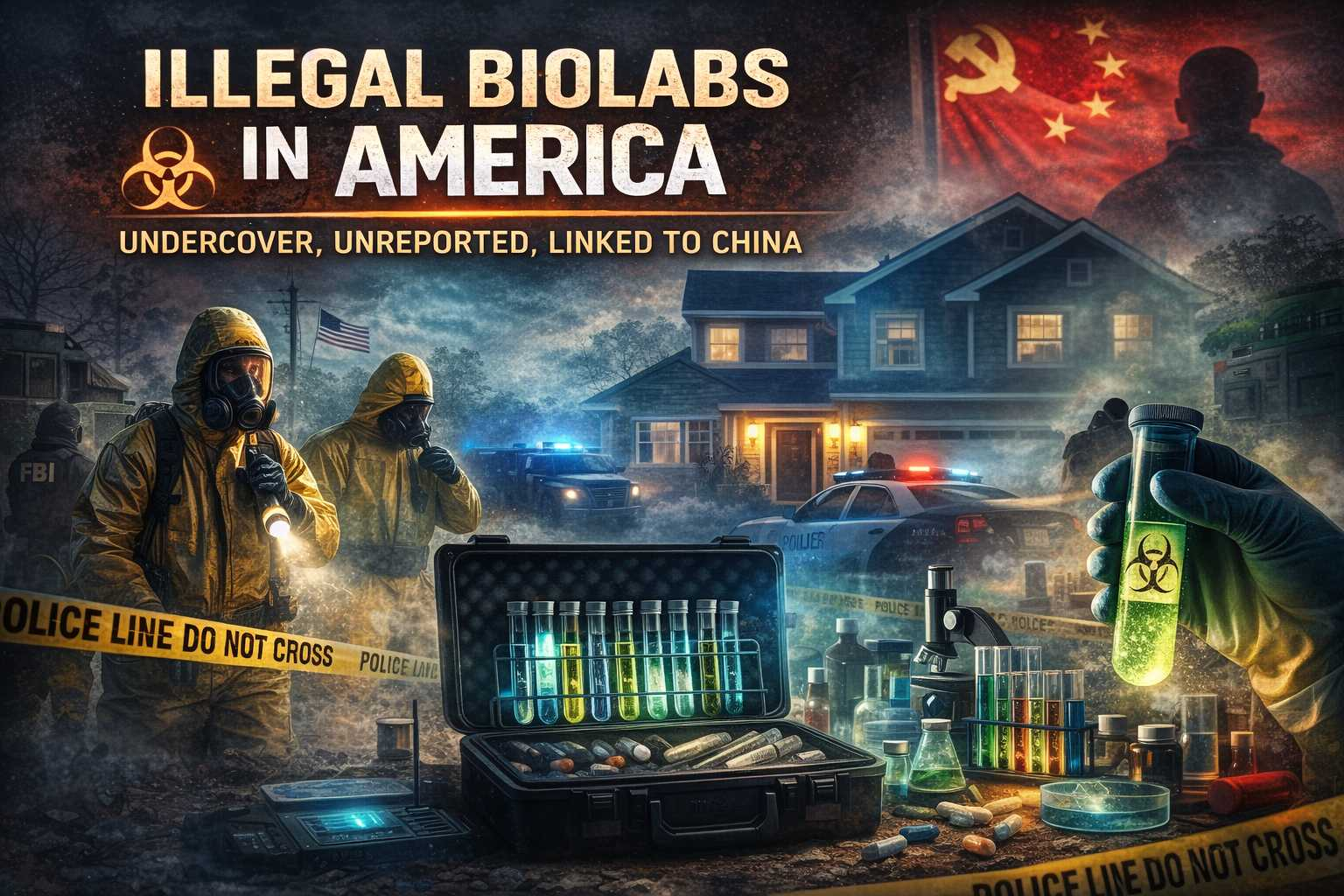
The bigger story is back home—quiet, underreported, and sitting right inside the United States: illegal biolabs being discovered in residential neighborhoods, linked again and again to Chinese nationals and networks tied back—directly or indirectly—to the PRC.

If you’ve missed the headlines (or noticed how quickly they disappeared), you’re not alone. That’s exactly the problem.


“Biolab” shouldn’t be a scary word… until it is

Let’s lower the temperature for a second, because “biolab” has become a loaded term. A “biolab” can be a veterinary clinic lab. It can be a hospital lab. It can be a university lab doing legitimate work.

But here’s where it becomes a serious problem:

When authorities find unlicensed, clandestine labs in houses or warehouses—stocked with unlabeled vials, unknown agents, and unsafe storage—then we are no longer talking about normal science. We’re talking about a public safety threat.

And when those operations keep showing ties to PRC-linked individuals and funding streams, we’re talking about something bigger than “some guy doing weird experiments in his garage.”


The Las Vegas bust: what we know so far

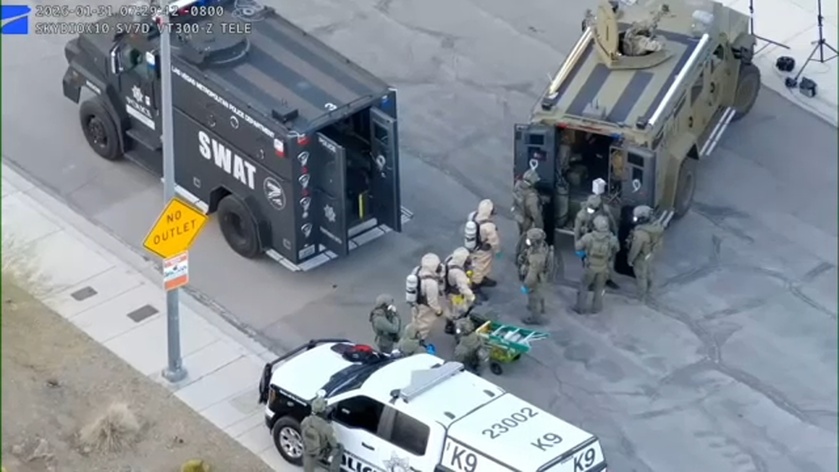
The newest case—just days ago—was in the Las Vegas area. A SWAT team and the FBI executed search warrants after reports of a possible biological laboratory. Investigators found refrigerators containing vials of unknown liquids, unmarked and unidentified, and hazmat teams were brought in. At least one person on scene was detained, apparently a caretaker, and investigators traced links to an LLC associated with a Chinese national using an alias.

Here’s the key point:

Even before we know exactly what’s in those vials, we already know this is serious—because unlabeled biological materials in a residential setting force responders into a worst-case posture. Testing becomes slower, more dangerous, and more complicated, because you can’t assume anything.

And Las Vegas isn’t isolated.
 

Smuggling biological materials into U.S. research ecosystems

When you back up and look over the last couple of years, the same themes repeat:

  • Biological materials brought in illegally

  • False statements to Customs and Border Protection

  • Shipments concealed to evade inspection

  • Connections to PRC institutions, or individuals with CCP/PLA ties

  • Work funneling toward U.S. lab capacity—because our labs are often more advanced

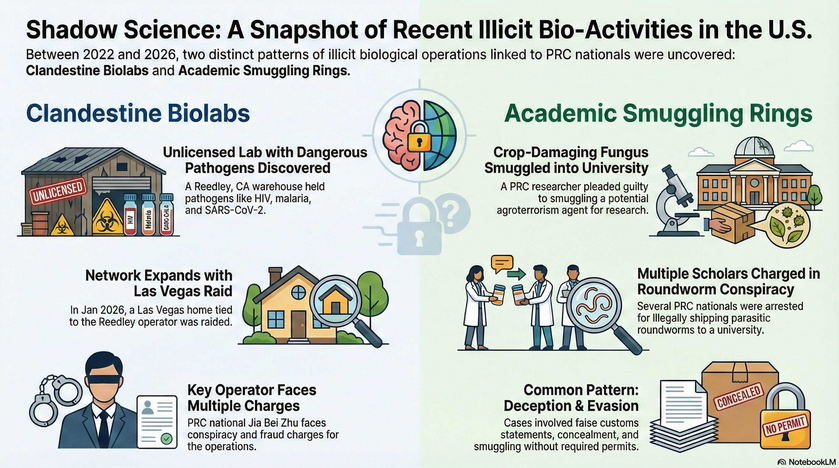
Some of the cases discussed involve smuggling parasite samples (including roundworm-related materials) and a dangerous crop fungus. Even if you strip away speculation, one fact remains:

Smuggling biological agents into the United States is not a paperwork mistake. It’s a red-flag behavior.

And the agricultural angle matters more than most people realize. If someone wanted to cause chaos and suffering without firing a single shot, they wouldn’t start with tanks. They’d start with food supply disruption—crops, livestock, transport, processing.

That’s not sensationalism. That’s simply understanding how fragile modern systems can be when a single link breaks.

Reedley, California: the case that should have changed everything

The most chilling example brought up in the discussion is the earlier discovery of an unlicensed lab in Reedley, California—uncovered in late 2022 and publicly discussed later as investigators tested and expanded the case.

What was found there was the kind of thing that should make every American ask: How did this exist on U.S. soil at all?

Reports discussed:

  • Large numbers of unmarked vials

  • A range of pathogens identified in testing

  • Hazardous chemicals improperly stored

  • Medical waste

  • Improvised, unsafe lab conditions

  • A significant number of genetically altered mice used for research purposes

Whether the operation was profit-driven, espionage-driven, or both, you don’t end up with that kind of setup by accident.


Only for Supporters
To read the rest of this article and access other paid content, you must be a supporter
8
What else you may like…
Videos
Podcasts
Posts
Articles
Israel Makes a Commercial from its Critics

Love this.

00:00:49
Pahlavi Speaks Out Against Leftist Journalists

The Prince hits back at the spectacularly one-sided coverage the war is getting in Europe. Powerful stuff.

00:04:24
How easy can you be found from your online presence?

Take a look at this video and show it to your kids.

00:03:50
Episode 622 - Field Producer Dennis Azato and Chuck Reminisce

My erstwhile field producer and cameraman Dennis Azato has accompanied me on ten years of adventures across the globe. Today he joins me in Ukraine and we spend some time remembering our many trips together.

Episode 622 - Field Producer Dennis Azato and Chuck Reminisce

THANK GOD for Republicans who fix damage done by democrats and etc. THANK GOD Henceforth for President Trump to Governor DeSantis:

post photo preview

We just wrapped up an incredible week in Panama with a group of Hot Zonians. It was a powerful time of connection, faith, and adventure.

We are excited to announce new dates for our next Panama Tour: October 14 through 19, 2027!

This is a rare opportunity to step away from the noise and spend intentional time with Chuck in a relaxed, small group setting. This is not a packed, exhausting trip. It is designed for real connection, meaningful conversations, and experiencing Panama at a pace that allows you to truly take it in.

Over six unforgettable days, you will explore the best of Panama from the vibrant energy of Panama City to the peaceful beauty of El Valle de Antón. There will be casual hikes, a beach day, visits to local hidden gems, and plenty of downtime to recharge and connect.

Trip Highlights

Quality one-on-one time with Chuck in a personal and relaxed setting
Scenic hikes, beach time, and a visit to the world-famous Panama Canal
Plenty of free time to rest, reflect, and build ...

post photo preview

We embrace servanthood because we were saved by the Greatest Servant. Therefore, to be His disciple, we must be willing to humble ourselves, and learn from Him how to serve and love like Him (Matthew 11:29). Living entirely for our heavenly Father's will and glory, as our Lord Jesus did, when He physically walked this planet.

"He who says he abides in Him ought himself also to walk even as He walked."
(1 John 2:6)

Live Call With Chuck Link
What Do YOU Want To Ask Chuck?

Tomorrow at 12:00 PM New York time, we are going live with Chuck for our supporter call.

So let me ask you this… what do YOU want to ask Chuck? What’s been on your mind after these last few episodes? What do you want clarity on? What are you not hearing answered anywhere else?

Drop your questions in the comments here or go back to the original post and add them there.

We’re going through all of them and pulling the best ones for the call. Don’t hold back; we can talk openly in these calls. 


Join the call here: https://meet.google.com/iqr-tope-rqz

Read full Article
post photo preview
This War Isn’t Slowing Down—And That Changes Everything

In a recent briefing, President Donald Trump made something unmistakably clear: this war is not operating on a timeline, and it is not approaching a natural pause. Instead, it is accelerating in both scope and intensity, moving beyond limited strikes into a sustained campaign that is beginning to reshape the strategic landscape of the Middle East in real time.

That reality alone should force a reassessment of how this conflict is being understood, because what may have initially appeared to be a short, decisive military operation is now evolving into something far more complex, with consequences that extend well beyond the immediate battlefield.

From Targeted Strikes to Sustained Pressure

The early phase of the war was defined by overwhelming force, as the United States and its allies executed a series of large-scale precision strikes against Iranian military infrastructure. Thousands of targets were hit, including missile systems, naval assets, and weapons production facilities, resulting in the significant degradation of Iran’s conventional military capabilities.

In addition to the air campaign, the United States implemented a sweeping naval blockade designed to isolate Iran economically and militarily, effectively placing the entirety of its coastline under surveillance and control.

At first glance, these actions created the impression of a decisive and controlled campaign, one in which the outcome seemed largely predetermined by the imbalance of military power.

But wars are rarely decided in their opening phase.

A War That Has Moved to the Sea

What has emerged more recently—and what the latest developments highlight—is a shift toward a more dangerous and unpredictable phase centered on maritime conflict.

The Strait of Hormuz, one of the most strategically critical waterways in the world, has become a focal point of confrontation, with Iranian forces targeting commercial vessels and attempting to disrupt global shipping lanes. In response, the United States has escalated its posture, ordering naval forces to take direct and lethal action against Iranian boats engaged in mine-laying operations.

This directive represents more than a tactical adjustment; it signals a transition into a more aggressive and persistent form of engagement, one that increases the likelihood of miscalculation and rapid escalation.

The presence of multiple U.S. warships, aircraft, and mine-clearing operations in the region underscores the seriousness of the situation, as does the growing number of incidents involving attacks on commercial shipping.

What is unfolding in the Strait is not a sideshow—it is a central front in a conflict that now directly impacts global trade and energy markets.

Why Dominance Does Not Equal Resolution

Despite the clear military advantage held by the United States, there are signs that the conflict is entering a phase where superiority alone may not be enough to achieve a decisive outcome.

Iran’s naval capabilities have been severely degraded, and a large portion of its military infrastructure has been damaged or destroyed.

And yet, the continued ability of Iranian forces to disrupt shipping, deploy mines, and conduct asymmetric attacks reveals a deeper truth about modern warfare: even a weakened adversary can remain dangerous when it adapts its strategy.

This is particularly evident in the use of small, fast-attack boats and decentralized tactics, which allow Iran to operate in ways that are difficult to fully counter through conventional means.

In other words, the battlefield has shifted from one of direct confrontation to one of persistent disruption.

The Strategic Stakes Are Global

Only for Supporters
To read the rest of this article and access other paid content, you must be a supporter
Read full Article
The War Is Expanding in Ways Most People Still Don’t Understand

When you look at a war from a distance, it often appears as a series of disconnected events—headlines that flare up for a moment before being replaced by the next crisis—but when you step closer, when you begin to follow the patterns instead of the noise, you start to see something else entirely taking shape.

That’s where we are right now.

Natanz (satellite view)


Because what’s happening in the Middle East is no longer just a regional conflict or a contained military campaign; it is evolving into something broader, something more complex, and something that carries consequences far beyond the battlefield itself.

And yet, much of the world still hasn’t caught up to that reality.


A Campaign That Looks Decisive—On the Surface

From a strictly military perspective, the United States and its allies have demonstrated overwhelming capability in the early phase of this conflict, applying sustained pressure across multiple domains in a way that has steadily degraded Iran’s ability to operate as it once did.

Precision strikes have targeted key infrastructure, weapons systems, and logistical networks, while naval and air forces have established a level of dominance that allows for continued operations with relatively limited resistance.

In the span of weeks, thousands of targets have been hit, and the cumulative effect of those strikes is beginning to show, not just in the reduction of missile and drone activity, but in the overall tempo of Iran’s response.

There are fewer launches, fewer coordinated attacks, and more signs that the system is being strained.

From the outside, it looks like momentum is clearly on one side.

But that is only part of the story.


The Reality Beneath the Surface

Wars are rarely decided by what happens in the opening phase, and they are almost never as simple as they appear in the early days when one side seems to hold a decisive advantage.

Because beneath the visible structures—the bases, the launchers, the facilities—there exists a deeper layer of power that is far more difficult to dismantle.

In Iran’s case, that layer is not confined to a single institution or location; it is distributed across a network of political, military, and economic forces that are designed to function even under extreme pressure.

The clerical leadership provides ideological continuity, the civilian government maintains a façade of governance, and the Islamic Revolutionary Guard Corps operates as the backbone of real authority, controlling not only military assets but significant portions of the country’s economic infrastructure.

This is not a system that collapses simply because key targets are destroyed. It adapts. It absorbs damage. And it continues.


Why Air Power Has Limits

Only for Supporters
To read the rest of this article and access other paid content, you must be a supporter
Read full Article
See More
Available on mobile and TV devices
google store google store app store app store
google store google store app tv store app tv store amazon store amazon store roku store roku store
Powered by Locals