Chuck Holton
Politics • Culture • News
On the Ground in Kyiv: Russia Escalates, Ukraine Endures
November 20, 2025
post photo preview

I’m coming to you tonight from my hotel room in Kyiv. In just a few minutes, Nathan and I will head out to catch the night train south. But before we go, I need to bring you a full, unfiltered, on-the-ground update—because today revealed a truth most people in the West never see:

Life in Kyiv goes on… even as Russia tries every day to break it.

A City That Refuses to Die

We spent the day in downtown Kyiv—Khreschatyk Street, Maidan Square, all the places that became symbols of freedom back in 2014. I was here during the Maidan Revolution. I saw the burned-out bank. I stood at the plaza where over a hundred protesters were massacred by Russian-backed agents.
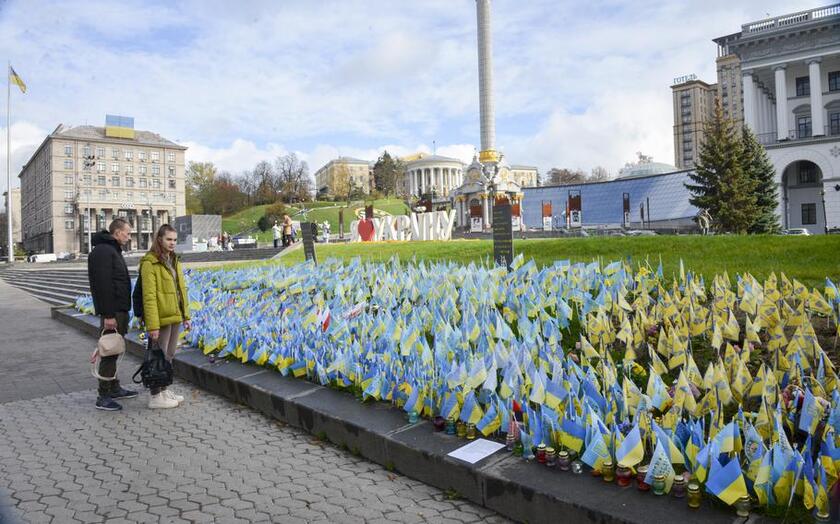
Today, that same square is full of families, strollers, workers, tourists. People are drinking coffee, playing with their kids, going to work. The only thing that hints at the cost is the long row of Ukrainian flags—each one representing a soldier who has died defending their country.

Sixty thousand dead.
Sixty thousand too many.

And still, they endure.

The Hidden War You Don’t See

If you drove around Kyiv today, you might not even realize the city gets attacked almost every single night. The damage is there—you just have to know where to look. Very often, you need someone local to take you to a block that was hit the night before.

That’s the reality here: Russia’s missiles don’t destroy a city—they destroy families.

This morning, a Kinzhal missile—a huge 20-foot-long monster carrying a ton of explosives—hit an apartment building in Ternopil. One moment people were sleeping. The next moment their world was fire, smoke, shards of glass, collapsed walls, and screaming.

At least 20 dead, 66 injured and many still missing.

The “Human Safari” — Russia’s Teenagers Trained to Kill Civilians

If you watched yesterday’s report, you saw it yourself: Russian suicide drones flown by teenage operators being trained not to hit military targets…

…but any white civilian vehicle.

I watched video after video—posted proudly by Russian channels themselves—of drones cruising down highways, slipping under camouflage nets, and waiting for a civilian car to pass.

Russia calls it the “human safari.”
That’s not my term. That’s theirs.

If you ever had doubts about who is targeting civilians—those doubts should be dead and buried now.

Ukraine Isn’t Losing—And Russia Knows It

The Western narrative says Ukraine is on the ropes.

That's wrong.

After spending the day with high-ranking Ukrainian commanders—men with decades of service, men who’ve lost friends, homes, even their own churches—I can tell you this:

They’re confident.
They’re committed.
And right now, they believe they are winning.

Ukraine is:

  • Striking Russian infrastructure deep inside enemy territory

  • Improving air defenses with new U.S. Patriot interceptors

  • Innovating new forms of drone warfare faster than any nation on earth

  • Gaining momentum on multiple fronts

Meanwhile, Russia is:

  • Using Iranian-made drones

  • Sending men into combat on Chinese motorcycles

  • Losing hundreds of thousands of troops

  • Relying on terror because they cannot win on the battlefield

One commander told me bluntly:
“If we stay united, Russia cannot win this war.”

Europe Is Waking Up — Fast

This past week alone:

  • Russian saboteurs blew up rail tracks in Poland

  • Russian drones violated NATO airspace in Poland, Romania, and Moldova

  • German leadership announced NATO may be at war with Russia as early as 2026

  • A Russian spy ship began dragging for undersea cables near the UK, prompting a military standoff

Europe is mobilizing.
Poland is practically foaming at the mouth to engage.
NATO knows the clock is ticking.

The Church Under Fire—but Growing

One of the most powerful stories today came from a Christian pastor—one of the most famous worship leaders in Ukraine, once even in Russia.

He’s lost two homes in this war.
He’s been beaten by Russian forces.
His church in Melitopol was taken.
His apartment in Kyiv was destroyed just three weeks ago.

And yet…

His new church has grown from 4 families to over 500 people in less than a year.

People are hungry for hope. They’re asking for Bibles. They’re showing up to pray. They’re coming to Christ in the middle of the fire.

Addressing the Critics

Every time I report from Ukraine, someone asks:

“Why should American taxpayers help Ukraine?”
“What about hungry kids in America?”
“Isn’t Ukraine corrupt?”
“Shouldn’t we stay out of it?”

Let me answer plainly:

  • We made written commitments to support Ukraine's security decades ago.

  • If America abandons allies, America has no allies.

  • If we leave the world stage, Russia, China, and Iran will shape the next century.

  • Ukraine is teaching the U.S. military how to fight modern war.

  • The money we send is less than 10% of our annual defense budget—and far cheaper than fighting Russia ourselves.

And the hungry kids in America?

That’s the job of churches, communities, and citizens—not the Pentagon.

The Human Cost You Cannot Ignore

Watch this translation from a woman in Kherson—an elderly Christian woman who has lived hell on earth:

“I saw the homes burning.
I lived in the basement because I couldn’t walk.
I saw everything.
This is a nightmare.
My son is fighting.
Our young people are dying.
How much more can we endure?”

If your heart doesn’t break hearing that…

…you might want to check if you still have one.

Where This Is Going

This war is not slowing down.
If anything, it’s accelerating.

  • NATO countries are preparing for open conflict

  • Russia is escalating asymmetric attacks across Europe

  • Millions remain displaced

  • Ukraine continues fighting with everything it has

And today, Nathan and I will be back on the front lines—to bring help where we can, and to keep showing you what the mainstream media refuses to show.

Pray for us tonight as we take the night train south.

We’re going to keep telling the truth.
We’re going to keep helping the people who need it most.
And we’re going to keep exposing Russia’s war on civilians.

This is the Hot Zone.
And this is what’s really happening.

community logo
Join the Chuck Holton Community
To read more articles like this, sign up and join my community today
10
What else you may like…
Videos
Podcasts
Posts
Articles
More Fraud - This Time in Ohio
00:01:39
Do American Students Know Anything?

Another powerful ad for home schooling.

00:01:30
Powerful

No one in Ukraine asked for this.

00:02:32
Episode 622 - Field Producer Dennis Azato and Chuck Reminisce

My erstwhile field producer and cameraman Dennis Azato has accompanied me on ten years of adventures across the globe. Today he joins me in Ukraine and we spend some time remembering our many trips together.

Episode 622 - Field Producer Dennis Azato and Chuck Reminisce
Get a Signed Book from Chuck Holton with Your Annual Locals Membership – Limited Time Offer Ends Jan 1

Sign up for an annual Locals membership now through January 1st and Chuck will personally send you a signed book as a thank-you. The annual plan is currently discounted to only $5 a month, saving you $48 for the year.

To receive your book, you must join with an annual membership, then email [email protected] with your mailing address and your book choice.

Supplies are limited to what we have in stock.

https://chuckholton.locals.com/support/promo/CHRISTMAS2026

post photo preview
December 29, 2025

Be careful about these Victor Davis Hanson videos. They are AI fakes. He has been pointing them out on his real show VICTOR DAVIS HANSON, IN HIS OWN WORDS on the Daily Signal.

December 28, 2025

This is the second time a great leader got the snub when arriving in the USA. It's no wonder our allies no longer trust us. Sad, really sad.
Who remembers who this happened to under Biden? I'm almost embarrassed to say I'm from the USA.

Christmas Special Live Call Link

Reminder: Live Call with Chuck Tomorrow at 12PM

Join Chuck Holton and the Hot Zone crew tomorrow, December 20th at 12PM for a special live call!

We’ll be announcing the winners of the Christmas giveaway and giving you an inside look at what’s coming next for The Hot Zone.


Only for Supporters
To read the rest of this article and access other paid content, you must be a supporter
Read full Article
post photo preview
Three Americans Killed in Syria — and the Question Washington Doesn’t Want to Answer

Breaking news this Saturday: three Americans are dead in Syria tonight, three more are wounded, and the attack—described by U.S. Central Command as an ambush carried out by a lone ISIS gunman—has once again dragged the Syrian war back into the American consciousness for a few brief hours, which is usually all the time the public gives it before the news cycle moves on and the families are left to carry the weight alone.


CENTCOM says two of the dead were U.S. service members and one was an American civilian contractor, and that the attacker was engaged and killed as well, with names being withheld until next of kin are notified, which is the right thing to do; but even with those official facts in hand, I want to slow the pace down a little bit and do what I always try to do here—put this in context—because in a place like Syria, the story you get in the headline is almost never the story that explains why this happened.

I’m not interested in reporting tragedy like it’s a scoreboard, and I’m not interested in repeating a paragraph of breaking news without the background that makes it intelligible; I spent eight years in the military, and I’ve spent more than twenty years following the U.S. military across the globe—Afghanistan, Iraq, and Syria included, with more than a dozen trips into Afghanistan, roughly fifteen into Iraq, and seven or so into Syria—so when Americans die in a place most people couldn’t find on a map, I feel a responsibility to show you what the map actually means.

The desert isn’t empty—ISIS hides in the “nothing”

The reported location of the attack is Palmyra—Palmira on some maps—an ancient city in central Syria that sits on the edge of a brutal expanse of desert, the kind of wide open, sun-blasted country where outsiders assume nothing lives and nothing happens, when in reality it’s exactly the kind of terrain insurgents love because “nothing” is a perfect disguise, a perfect place to move, cache weapons, blend into small villages, disappear into wadis, and wait for opportunities.

Palmyra also sits inside territory controlled by Syria’s new administration under Ahmed al-Sharaa, and if that name makes you pause, it should, because this is where Syrian politics gets complicated in the way only Syria can do: al-Sharaa rose through jihadist ranks, he has a history tied to insurgent warfare against Americans in Iraq, he was captured and held for years, and he later returned to Syria and consolidated power with strong Turkish backing—so when you hear phrases like “new Syrian administration” or “transitional government,” don’t imagine a Western-style democracy that suddenly appeared out of the sand; imagine a patchwork of militias, alliances of convenience, old enemies wearing new uniforms, and a leadership class that wants international legitimacy while carrying a past that cannot be scrubbed clean with a new suit and a new flag.

Now layer on top of that the reality that ISIS is not gone from Syria, not even close.

U.S. estimates have long suggested there are still roughly 2,000 to 3,000 ISIS fighters operating in and around the central Syrian desert, and there are far more than that if you include facilitators, family networks, financiers, and the enormous number of ISIS-linked detainees and relatives held in camps and makeshift prisons; and while that fight has mostly slipped out of the American public’s view, it continues quietly, relentlessly, week after week, because the moment pressure is relieved in a place like this, the violence doesn’t fade—it regroups.

Why American troops are still there—despite everything

The United States currently has about 900 troops in Syria, a number that matters because it tells you how thin the margin is between “containment” and “collapse,” especially when the enemy has deep local roots and decades of practice living off the land and off the grievances of the people around them; and those American troops are there for one primary purpose: to keep a lid on ISIS so we don’t wake up one day to another wave of mass executions, terror-state governance, and regional destabilization that forces the world back into a far more expensive war.

That’s the mission, and it’s not abstract; when ISIS surged the last time, the human cost was staggering, and it wasn’t paid by politicians or pundits—it was paid by Iraqi soldiers, Kurdish fighters, civilians, and yes, Americans too—and the reason our presence in Syria still functions as a deterrent is that in a powder keg region, a small, capable American footprint has a way of discouraging ambitious actors from taking the final step that turns instability into open war.

But here is the part that doesn’t get said out loud very often: the mission in Syria is increasingly tangled up in partnerships that are, at best, uneasy and, at worst, morally and strategically risky.

Only for Supporters
To read the rest of this article and access other paid content, you must be a supporter
Read full Article
post photo preview
The Dark Fleet Is Fueling the World’s Dictators — And the U.S. Might Finally Be Ready to Do Something About It

I’m coming to you today from Panama, where I’ve been digging into a story that’s far bigger than most people realize. It involves a shadowy network of ships—1,423 of them at last count—that roam the world’s oceans moving sanctioned oil for regimes like Russia, Iran, and Venezuela. Some call it the dark fleet, others the ghost fleet, but whatever the name, it’s become a lifeline for the world’s worst dictators.

Out of those 1,423 vessels, roughly 920 are sanctioned themselves. These aren’t just ships doing business in a gray area—they are part of a global ecosystem of deception, fraud, and corruption that props up authoritarian governments and undermines the international rules that keep maritime trade safe. They spoof GPS signals, turn off their transponders, swap oil with “cleaner” tankers in the dead of night, operate under shell-company ownership, and sail uninsured—floating environmental disasters just waiting to happen.

And for years, not much was done about it. But that may be changing.

Just days ago, the United States seized a massive VLCC tanker—the Skipper—carrying 1.8 million barrels of Venezuelan crude bound for Cuba. It’s a move that seems small on its own, but it hints at something larger: Washington may finally be realizing that targeting the dark fleet isn’t just desirable—it’s strategically powerful.

That raises a fascinating question: What would happen if the U.S. and its allies cracked down hard on these ghost ships—everywhere, all at once? Could it reshape global power? Could it even topple Maduro?

Let’s dig into that.


A Sanctions Loophole Big Enough to Sail a Tanker Through

These ghost ships function by exploiting cracks in the global maritime system. They manipulate AIS beacons, swap oil mid-ocean, hide ownership behind layers of shell companies, fly false flags, and operate without legitimate insurance. The UN’s maritime regulator has warned that these rusted, poorly maintained hulks are ticking time bombs—and we’ve already seen “Ukrainian sanctions” in action when Ukrainian sea drones blew up several shadow-fleet tankers in the Black Sea.

Imagine what happens if one of these decrepit tankers explodes in a global choke point like the Strait of Hormuz. You’d see a shock to oil markets overnight.

And yet, that’s the system that keeps Venezuela, Iran, and Russia afloat.


The U.S. Begins to Apply Pressure

The seizure of the Skipper wasn’t random. It’s part of a broader pressure campaign—one that former Secretary of State Mike Pompeo has openly supported. He said plainly that going after these vessels is a direct way to choke off the revenue Maduro depends on to stay in power.

Pompeo also noted something key: Maduro’s regime probably has “weeks, not months” of financial runway without this illicit revenue stream. And Cuba—already experiencing rolling blackouts—relies on Venezuela for about a quarter of its total energy supply. This single tanker seizure hurts Havana even more than Caracas.

But perhaps the most important variable is geography. Satellite data reveals dozens of sanctioned tankers parked just off Venezuela’s northern coast. In theory, if the U.S. waits for them to exit Venezuela’s 200-mile EEZ, it could legally seize many of them—especially the stateless ones.

Imagine the U.S. grabbing one tanker per day.

The ripple effects would be enormous.

Only for Supporters
To read the rest of this article and access other paid content, you must be a supporter
Read full Article
See More
Available on mobile and TV devices
google store google store app store app store
google store google store app tv store app tv store amazon store amazon store roku store roku store
Powered by Locals