Chuck Holton
Politics • Culture • News
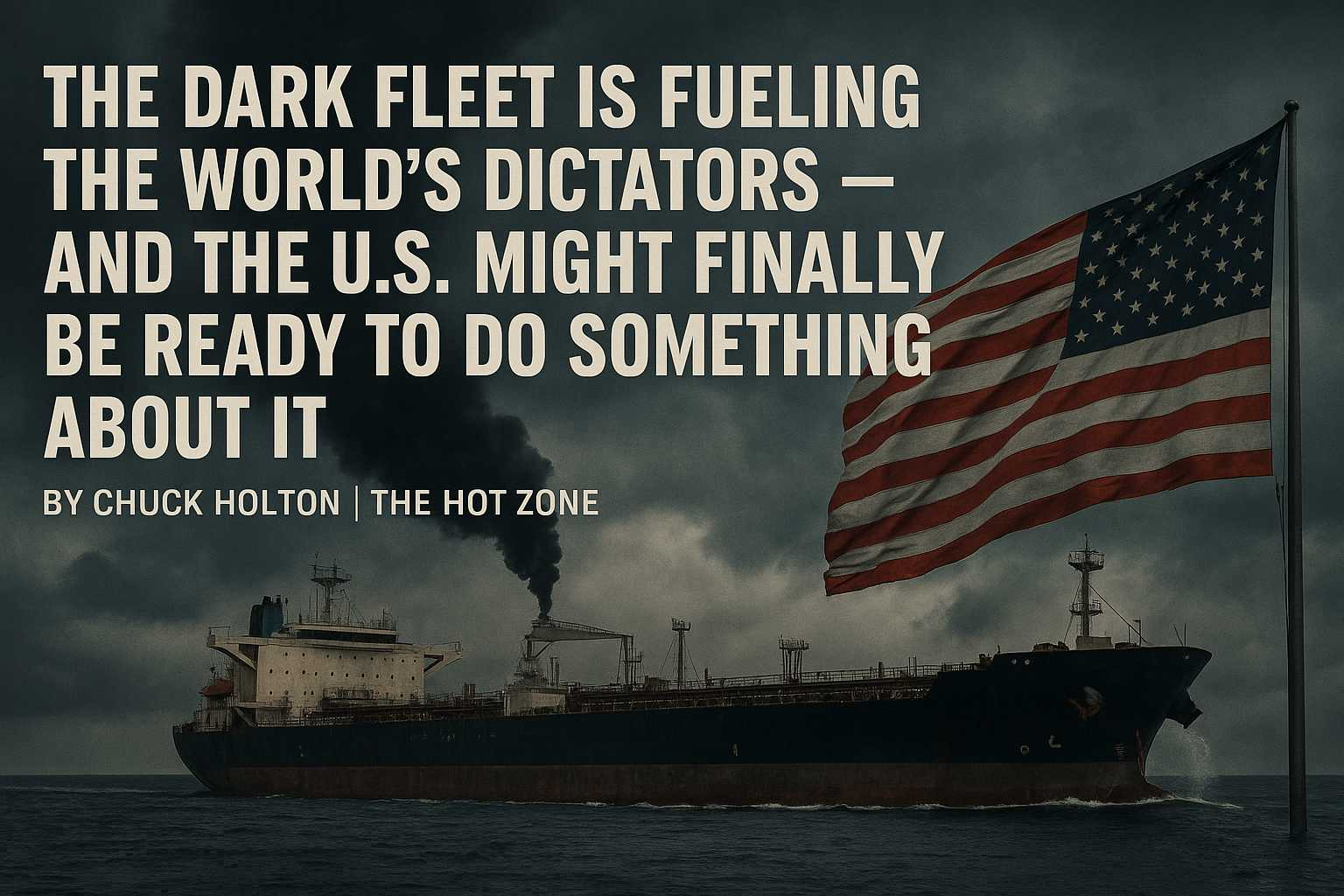
The Dark Fleet Is Fueling the World’s Dictators — And the U.S. Might Finally Be Ready to Do Something About It
9 hours ago
post photo preview

I’m coming to you today from Panama, where I’ve been digging into a story that’s far bigger than most people realize. It involves a shadowy network of ships—1,423 of them at last count—that roam the world’s oceans moving sanctioned oil for regimes like Russia, Iran, and Venezuela. Some call it the dark fleet, others the ghost fleet, but whatever the name, it’s become a lifeline for the world’s worst dictators.

Out of those 1,423 vessels, roughly 920 are sanctioned themselves. These aren’t just ships doing business in a gray area—they are part of a global ecosystem of deception, fraud, and corruption that props up authoritarian governments and undermines the international rules that keep maritime trade safe. They spoof GPS signals, turn off their transponders, swap oil with “cleaner” tankers in the dead of night, operate under shell-company ownership, and sail uninsured—floating environmental disasters just waiting to happen.

And for years, not much was done about it. But that may be changing.

Just days ago, the United States seized a massive VLCC tanker—the Skipper—carrying 1.8 million barrels of Venezuelan crude bound for Cuba. It’s a move that seems small on its own, but it hints at something larger: Washington may finally be realizing that targeting the dark fleet isn’t just desirable—it’s strategically powerful.

That raises a fascinating question: What would happen if the U.S. and its allies cracked down hard on these ghost ships—everywhere, all at once? Could it reshape global power? Could it even topple Maduro?

Let’s dig into that.


A Sanctions Loophole Big Enough to Sail a Tanker Through

These ghost ships function by exploiting cracks in the global maritime system. They manipulate AIS beacons, swap oil mid-ocean, hide ownership behind layers of shell companies, fly false flags, and operate without legitimate insurance. The UN’s maritime regulator has warned that these rusted, poorly maintained hulks are ticking time bombs—and we’ve already seen “Ukrainian sanctions” in action when Ukrainian sea drones blew up several shadow-fleet tankers in the Black Sea.

Imagine what happens if one of these decrepit tankers explodes in a global choke point like the Strait of Hormuz. You’d see a shock to oil markets overnight.

And yet, that’s the system that keeps Venezuela, Iran, and Russia afloat.


The U.S. Begins to Apply Pressure

The seizure of the Skipper wasn’t random. It’s part of a broader pressure campaign—one that former Secretary of State Mike Pompeo has openly supported. He said plainly that going after these vessels is a direct way to choke off the revenue Maduro depends on to stay in power.

Pompeo also noted something key: Maduro’s regime probably has “weeks, not months” of financial runway without this illicit revenue stream. And Cuba—already experiencing rolling blackouts—relies on Venezuela for about a quarter of its total energy supply. This single tanker seizure hurts Havana even more than Caracas.

But perhaps the most important variable is geography. Satellite data reveals dozens of sanctioned tankers parked just off Venezuela’s northern coast. In theory, if the U.S. waits for them to exit Venezuela’s 200-mile EEZ, it could legally seize many of them—especially the stateless ones.

Imagine the U.S. grabbing one tanker per day.

The ripple effects would be enormous.

Only for Supporters
To read the rest of this article and access other paid content, you must be a supporter
7
What else you may like…
Videos
Podcasts
Posts
Articles
Want to See What Combat is Like?

Several infantrymen from the Azov battalion clearing houses near Toretsk. Witness the utter destruction, and the horrific conditions created by this war. Warning: Foul language is used (in Ukrainian with subtitles)

00:12:51
September 18, 2025
Benjamin Netanyahu Explains the Israeli Economy

Netanyahu was once Israeli Finance Minister - and it shows. He understands a lot about economics, and is worth listening to in order to get a sense for where Israel's economy is headed.

00:08:49
September 12, 2025
Video of Kirk’s Killer

BREAKING: The FBI and state of Utah have just released video of the Charlie Kirk kiIIer escaping from the scene following the shooting

He jumped off the rooftop, moved quickly through the parking lot, and then began walking casually to blend in before entering a wooded area.

He was wearing converse tennis shoes, a shirt with an eagle, and a baseball cap with a triangle.

00:00:43
Episode 622 - Field Producer Dennis Azato and Chuck Reminisce

My erstwhile field producer and cameraman Dennis Azato has accompanied me on ten years of adventures across the globe. Today he joins me in Ukraine and we spend some time remembering our many trips together.

Episode 622 - Field Producer Dennis Azato and Chuck Reminisce
A few spots are still open for Chuck Holton’s private Panama retreat this April 9–14 — but not for long.

This isn’t a mission trip or a news assignment. It’s a rare, small-group getaway with Chuck in one of the most beautiful and fascinating places on earth.
No packed schedule. No chaos. Just meaningful connection, time to recharge, and unforgettable experiences, from the Panama Canal to the peaceful mountains of El Valle.

Trip Highlights:
– One-on-one time with Chuck in a relaxed setting
– Top-tier accommodations in Panama City and El Valle
– Scenic hikes, local markets, beach day, and more
– Time to reflect, explore, and connect

This is a rare chance to go deeper, unplug from the noise, and spend quality time with like-minded people and with Chuck.

Details & signup: https://www.holtonnews.com/panama-tour/
Space is extremely limited — grab your spot now.

post photo preview

We've all fallen short of God's glory, but through the redemption that's in Christ Jesus, we will share in it eternally (Romans 3:23-24)! This is our hope and boast in Him (Romans 5:2)!

"For you died, and your life has been hidden with Christ in God. When Christ our life is revealed, then you also will be revealed with Him in glory." (Colossians 3:3:4)

"As for me, I will see Your face in righteousness; I shall be satisfied when I awake in Your likeness." (Psalms 17:15)

Hallelujah, we have a glorious future; and He who has promised is faithful!

"May the God of hope fill you with all joy and peace in believing, that you may abound in hope through the power of the Holy Spirit."
(Romans 15:13)

This is real ✝️🛐🕊️

post photo preview
Russia's Psychological Warfare Against Ukraine Escalates in 2025

I went to Ukraine to see if Ukraine is crumbling under the pressure from Russia or if they are holding their own. The people on the frontline suffer from drones attacking civilians and missiles striking every day, and the people want an end to the war that won't end with them under the rule of Russia. Because if that happens, the Ukrainians will be wiped out completely. 

Only for Supporters
To read the rest of this article and access other paid content, you must be a supporter
Read full Article
post photo preview
What Putin Really Wants — and Why the West Still Doesn’t Get It

We’re all watching the same headlines, scrolling the same feeds, and trying to make sense of the same chaos. And yet, for all the information at our fingertips, there are still some very basic questions we aren't answering honestly — like what Vladimir Putin actually wants, why this war in Ukraine keeps grinding on, and what it really means for the United States and our allies.

If you missed the LIVE, you can watch it HERE

Do We Still Keep Our Promises?

Whenever I go live, I like to ask people where they’re watching from. It’s not just a gimmick; it tells me something important. There are folks in Poland, Germany, Israel, Armenia, and all over the United States who have skin in the game with what we’re about to talk about. They’re not watching this as an abstract discussion. For some of them, this is about whether the ground under their feet will still belong to their country five years from now.

So I asked a simple question: Should the United States keep the commitments it has already made to its allies?

I’m not talking about getting involved in every brushfire conflict on the planet. I’m talking specifically about the promises we have already put our name on — treaties we signed, obligations we accepted, and expectations we created that other nations have built their security around.

The biggest of those, of course, is NATO — the North Atlantic Treaty Organization — created after World War II for one core purpose: to keep a check on Russia. That wasn’t paranoia. That was historical memory. Russia, whether under the czars, the Soviets, or Putin, has an almost compulsive habit of invading its neighbors. In just the last few decades, they’ve gone into Georgia, Chechnya, Crimea, and now full-on into Ukraine. They’ve made no secret of the fact that they believe they have a right to dominate not only their immediate borderlands, but the wider European sphere as well.

The problem is that while Russia has been very clear about its ambitions, the West has not been nearly as clear about its resolve.


The War You Don’t See: Russia’s Cognitive Offensive

If you only look at maps and front-line reports, you might conclude that Russia is stumbling. Their advances are slow and costly, their equipment is getting older, and they’re losing a lot of men. But you miss half the story if you stop there, because the real battlefield — the one Putin is betting on — is not just in trenches and ruined towns. It’s in the minds of voters in the United States and Europe.

Russian intelligence and state-backed actors have poured millions of dollars into what’s now being called cognitive warfare. They’ve set up SIM farms, bot farms, and propaganda networks across multiple continents. These aren’t just a few trolls on a laptop. We’re talking about industrial-scale operations — huge racks of phones and servers churning out fake profiles by the hundreds of thousands, posing as Texans, Brits, Indians, Germans, and everything else you can imagine.

Their purpose is simple and very specific:
to quietly steer public opinion away from supporting Ukraine, to paint NATO as the real villain, and to soften the West’s will to resist Russian aggression. They don’t need most people to become full-on pro-Russian. They just need enough people to become skeptical, weary, and divided. They know that democracies often defeat themselves from the inside long before an enemy ever crosses the border.


Why Putin Keeps Showing Up to “Peace Talks” He Doesn’t Mean

You may have noticed something about every “peace process” floated over the last two years. Russia walks in, sits down at the table, plays the reasonable partner for a few days or weeks, and then undercuts the deal or simply ignores it.

There’s a reason for that.

Putin’s strategy is not to end the war quickly. His strategy is to drag it out as long as possible while shaping the political terrain in the West. As long as he can keep the guns firing, he believes he can:

  • Grind down Ukraine’s manpower and infrastructure

  • Burn through Western political patience

  • Deepen divisions between Europe and the United States

  • Wait for elections or leadership changes to give him a more favorable climate

Only for Supporters
To read the rest of this article and access other paid content, you must be a supporter
Read full Article
post photo preview
The War in Israel Isn’t Over
Is this war actually winding down, or are we just in the eye of the storm?

From where I sit, the war in Israel is nowhere near over. It has simply changed shape. What started as a shock on October 7th has become a long, grinding contest across multiple fronts, and while the headlines may have grown tired, the stakes haven’t shrunk at all.

To understand what’s coming, you have to see the whole board, not just the one square called Gaza.


Five Fronts, One War

Israel is not dealing with a single isolated conflict. It is facing at least five interconnected fronts, each of them fragile and potentially explosive:

  1. Gaza

  2. Judea and Samaria (what the world insists on calling the West Bank)

  3. Lebanon

  4. Syria

  5. Iran and its proxy network

They overlap, feed into one another, and are all being influenced—directly or indirectly—by Tehran. When people talk about a “ceasefire,” they’re usually talking about Gaza. But if you zoom out, you’ll notice there has never really been a ceasefire at all.


Gaza: A “Ceasefire” in Name Only

Let’s start with Gaza, because that’s where most cameras still point, at least when they bother to look.

On paper, there’s been a ceasefire. On the ground, Hamas has been shooting at Israeli troops almost every day. There have been firefights, mortars, IED attacks, and at least a few IDF soldiers killed since that so-called pause went into effect.

The Israelis have divided the Strip into zones: a red zone where Hamas still controls the ground, and a green zone under IDF control. You’d think the green zone would be relatively stable, but in reality Hamas fighters keep emerging from tunnel shafts inside those areas and ambushing Israeli patrols. More than forty of those fighters have been killed in these incidents alone.

So if you’re picturing neat front lines and a quiet truce, erase that image. Gaza is still a warzone, it’s just a slower, dirtier, more subterranean version of the earlier stages.

The map we’re looking at right now will probably define Gaza for the foreseeable future. Israel is unlikely to pull completely out of the green zone anytime soon. If it did, there are at least nine local militias in that territory—tribal groups that hate Hamas—who would instantly start fighting for control. You’d see a civil war inside a war.

On top of that, Hamas still holds weapons, still has command structures, and still has fighters who believe, very sincerely, that Israel has no right to exist. That’s why Israel’s second war aim—after bringing the hostages home—was to dismantle Hamas as a fighting force. They have not finished that job, and they know it.


The Hostages and the Narrative of “Israel is Losing”

A lot of pundits you see online—especially people like Douglas Macgregor, Scott Ritter, and some of the usual talking heads—keep repeating the line that “Israel has lost this war” and is collapsing from within.

That claim doesn’t hold up.

Israel has managed to secure the return of every single hostage except one. When this war began, I honestly didn’t think that was possible. The chaos in Gaza, the tunnel networks, the sheer brutality of Hamas made it seem almost inevitable that many captives would simply disappear—killed, buried, or used as human shields until the end.

Yet here we are: one hostage still unaccounted for, and even his remains may soon be recovered. That is an extraordinary outcome by any military or intelligence standard, and it is a victory no matter what the doom-mongers say.

At the same time, Israel has been quietly preparing for the next phase. Their defensive capabilities are actually stronger now than they were on October 6th. The Iron Beam laser defense system—something the United States and Russia both struggled to make operational—is finally being fielded. It’s not science fiction anymore; it’s an actual working layer in their air-defense umbrella. That’s going to matter a lot if this war expands into a full regional conflict.

So no, Israel is not crumbling. It is bruised, deeply divided internally in some ways, but militarily more ready than at any time since the fighting began.

Only for Supporters
To read the rest of this article and access other paid content, you must be a supporter
Read full Article
See More
Available on mobile and TV devices
google store google store app store app store
google store google store app tv store app tv store amazon store amazon store roku store roku store
Powered by Locals