




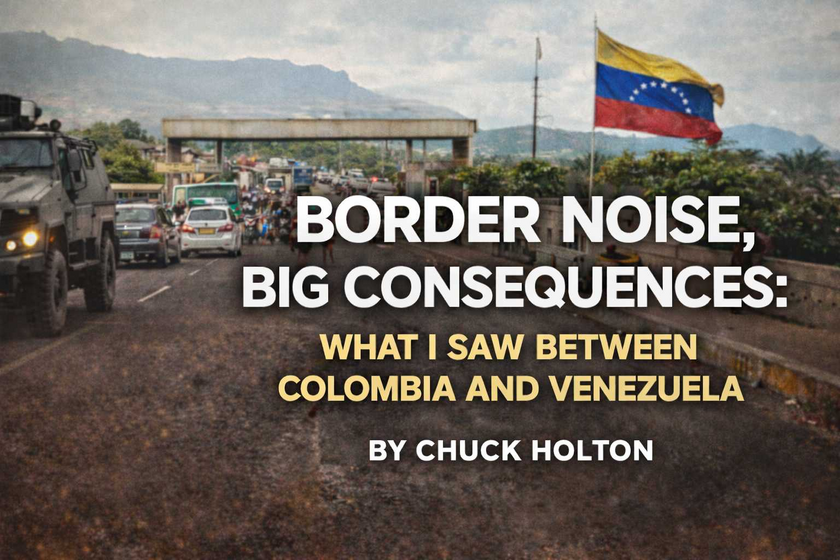
I’ve been traveling up and down the border between Venezuela and Colombia, stopping at different crossings to see what the situation looks like after the operation that removed Nicolás Maduro. At one crossing we got close enough to see Venezuelan soldiers checking cars under a big sign that reads “Welcome to Venezuela.” It was quiet—almost deceptively so.
But the crossing I’m at now? It’s chaos.
There are streams of vehicles and motorcycles pouring out of Venezuela… and, just as importantly, streams going back in. That’s the detail you have to notice. Because if this were a mass exodus, you’d see one-way traffic—people fleeing. Instead, you’re seeing something else:
This is commerce.
People crossing to Colombia to shop, to work, to take their kids to school—and then returning home. In many places along this border, it’s so open and routine that families live one way and function the other. Venezuelans send their kids to Colombian schools. They buy Colombian groceries. They haul back supplies—like the girl I saw riding on the back of a motorcycle carrying two 20-foot PVC pipes into Venezuela like it was the most normal thing in the world.
That’s the border in 2026: not a wall, not a line, but a living artery.
And right now, it’s carrying a lot more than backpacks and building supplies.
Trump vs. Petro: A Brewing Fight on the Wrong Border
While I’m standing here, you can see M117 armored personnel carriers behind me—vehicles the United States gave to Colombia. That matters because it ties directly into the developing political fight between President Trump and Colombian President Gustavo Petro.
Trump recently called Petro a “sick man,” accused him of being tied to the drug trade, and let’s be honest—Colombia has shipped more cocaine into the United States than most Americans realize.
Petro’s history doesn’t help him. He was a guerrilla in his youth. He claims he hasn’t touched a gun since the 1970s, but now he’s posturing publicly—saying he’s ready to pick one up again if that’s what it takes to defend Colombia from Donald Trump.
And here’s the thing: I’ve heard this movie before.
Just weeks ago, Maduro was taunting Trump—calling him a coward, daring him to come get him. And then… Trump did. Maduro dared the wrong man at the wrong time.
You’d think Petro might have learned something from that.
Instead, Petro is talking like a high-school junior in the schoolyard, puffing his chest out and saying, essentially: “Come on then.”
Which would be funny—if it weren’t so dangerous—because a lot of the Colombian military’s equipment, training, aviation support, and maintenance systems have historically been U.S.-supplied or U.S.-supported. The irony of threatening to fight America with America’s equipment isn’t lost on anyone here.
Petro has now called for nationwide protests tomorrow across Colombia—demonstrations aimed at Trump and the U.S. posture toward Petro’s government.
So tonight, we’re getting on a plane to Bogotá to attend what’s expected to be the biggest rally in the main downtown square.
If you want to know where the story is going next—it’s going there.
Caracas Was “Calm”… Until It Wasn’t
Now let’s talk about what happened in Caracas last night, because it reveals how fragile—and paranoid—the remaining regime really is.
There was confusion in the city. A drone was reportedly flying near sensitive areas. Some people insisted it was just a commercial drone—some kid with a DJI Mavic. But the response from Venezuelan forces was immediate and extreme:
They unleashed air defense fire into the sky—tracer rounds everywhere—and then armored vehicles flooded the area around the presidential palace.
That tells you two things: