In a recent briefing, President Donald Trump made something unmistakably clear: this war is not operating on a timeline, and it is not approaching a natural pause. Instead, it is accelerating in both scope and intensity, moving beyond limited strikes into a sustained campaign that is beginning to reshape the strategic landscape of the Middle East in real time.
That reality alone should force a reassessment of how this conflict is being understood, because what may have initially appeared to be a short, decisive military operation is now evolving into something far more complex, with consequences that extend well beyond the immediate battlefield.
From Targeted Strikes to Sustained Pressure
The early phase of the war was defined by overwhelming force, as the United States and its allies executed a series of large-scale precision strikes against Iranian military infrastructure. Thousands of targets were hit, including missile systems, naval assets, and weapons production facilities, resulting in the significant degradation of Iran’s conventional military capabilities.
In addition to the air campaign, the United States implemented a sweeping naval blockade designed to isolate Iran economically and militarily, effectively placing the entirety of its coastline under surveillance and control.
At first glance, these actions created the impression of a decisive and controlled campaign, one in which the outcome seemed largely predetermined by the imbalance of military power.
But wars are rarely decided in their opening phase.
A War That Has Moved to the Sea
What has emerged more recently—and what the latest developments highlight—is a shift toward a more dangerous and unpredictable phase centered on maritime conflict.
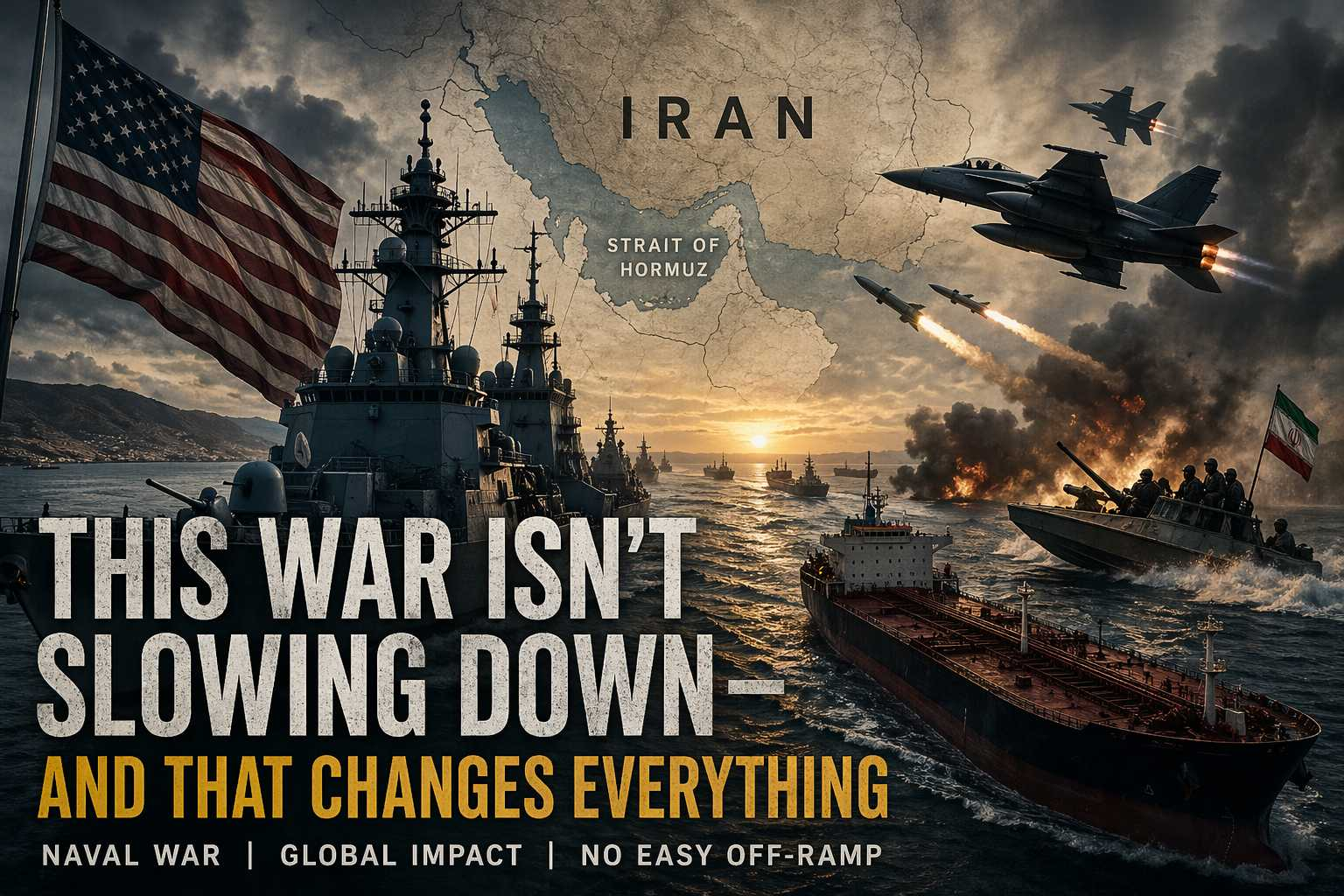
The Strait of Hormuz, one of the most strategically critical waterways in the world, has become a focal point of confrontation, with Iranian forces targeting commercial vessels and attempting to disrupt global shipping lanes. In response, the United States has escalated its posture, ordering naval forces to take direct and lethal action against Iranian boats engaged in mine-laying operations.
This directive represents more than a tactical adjustment; it signals a transition into a more aggressive and persistent form of engagement, one that increases the likelihood of miscalculation and rapid escalation.
The presence of multiple U.S. warships, aircraft, and mine-clearing operations in the region underscores the seriousness of the situation, as does the growing number of incidents involving attacks on commercial shipping.
What is unfolding in the Strait is not a sideshow—it is a central front in a conflict that now directly impacts global trade and energy markets.
Why Dominance Does Not Equal Resolution
Despite the clear military advantage held by the United States, there are signs that the conflict is entering a phase where superiority alone may not be enough to achieve a decisive outcome.
Iran’s naval capabilities have been severely degraded, and a large portion of its military infrastructure has been damaged or destroyed.
And yet, the continued ability of Iranian forces to disrupt shipping, deploy mines, and conduct asymmetric attacks reveals a deeper truth about modern warfare: even a weakened adversary can remain dangerous when it adapts its strategy.
This is particularly evident in the use of small, fast-attack boats and decentralized tactics, which allow Iran to operate in ways that are difficult to fully counter through conventional means.
In other words, the battlefield has shifted from one of direct confrontation to one of persistent disruption.