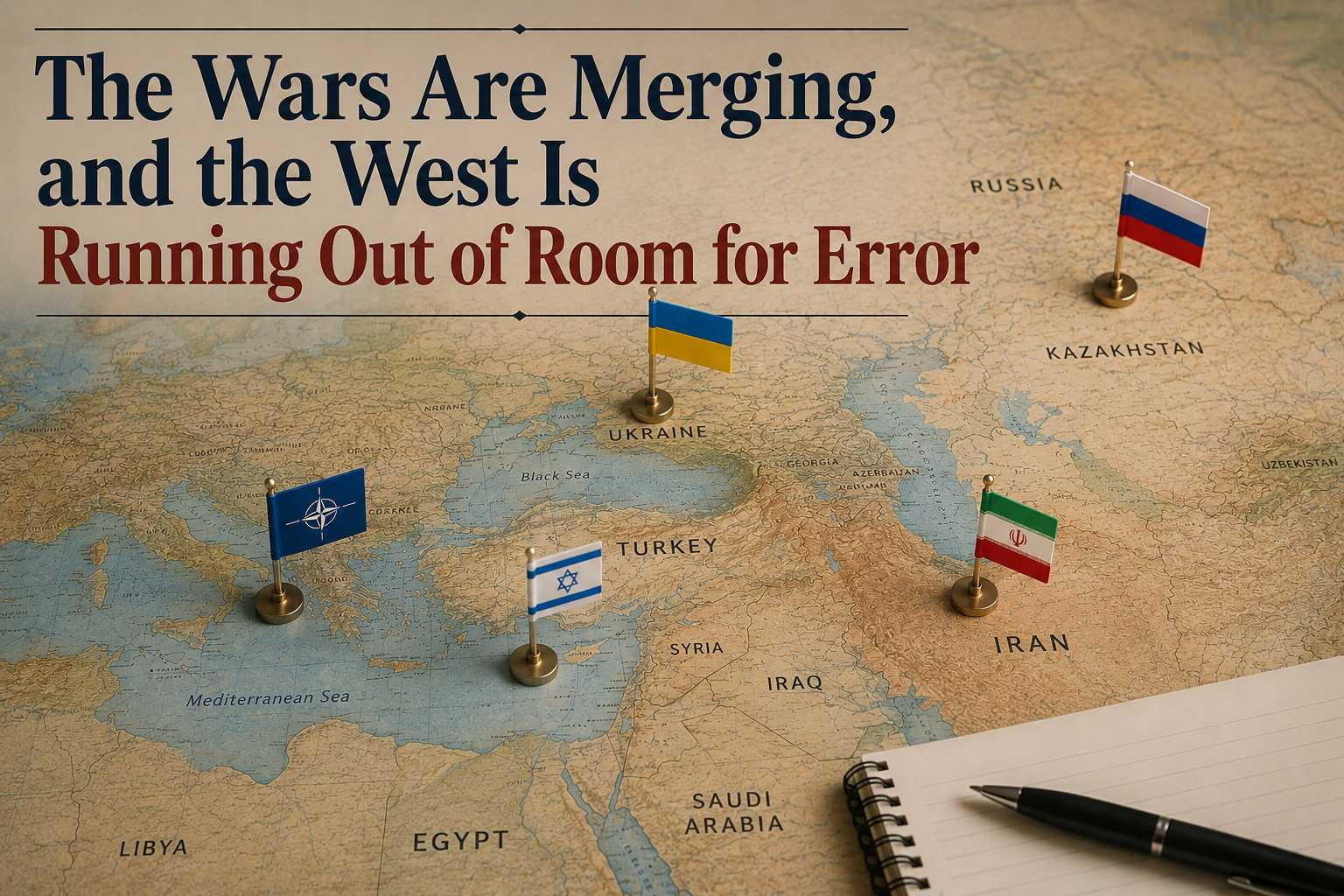
Iran is behaving less like a defeated power than a government convinced it can outlast the West, while Russia continues pressing NATO and Israel signals that it may be prepared to finish what Washington started. Increasingly, these conflicts look like parts of the same war.
By Chuck Holton
The news from the Middle East and Europe is becoming harder to divide into separate stories. Iran is under severe military and economic pressure but continues to act aggressively. Russia is supporting Tehran while prosecuting its war against Ukraine. NATO is increasingly concerned about the possibility of a direct confrontation with Moscow, and Israel is openly signaling that its campaign against the Iranian regime may not be finished.
Taken individually, each development is serious. Taken together, they point toward something much larger: the conflicts involving Iran, Russia, Israel, Ukraine, Europe and the United States are increasingly interconnected, while the West remains dangerously reluctant to acknowledge what that means.
President Donald Trump said this week that there are no talks or conversations scheduled with the Islamic Republic of Iran and that the naval blockade remains in effect. Yet Iran is hardly behaving like a country that considers itself beaten. Iranian officials have begun speaking about the war in the past tense and portraying the outcome as a victory that has established Iran as a dominant regional power.
That rhetoric would be easier to dismiss if Tehran were simultaneously showing signs of military submission. Instead, according to the developments covered in Wednesday's broadcast, Iran launched missiles and drones against the United Arab Emirates. The UAE subsequently announced that trade, commercial exchanges and financial transactions with Iran had been halted until further notice. Because the UAE had remained an important outlet for Iranian commerce despite the blockade, the decision could impose substantial additional economic pressure on Tehran.
Iran has undoubtedly suffered military damage. Its naval and air capabilities have been degraded, and its ability to manufacture weapons has been disrupted. But degraded is not the same as destroyed. Iran retains significant manpower and, critically, continues to possess the ability to produce drones and missiles. Drone production is especially difficult to eliminate because comparatively simple systems can be manufactured in dispersed facilities without the enormous industrial infrastructure required for sophisticated aircraft or warships.
The other problem is that Iran is not operating alone. Russia has reportedly continued providing Iran with military equipment and components, including shipments as recently as late July. Moscow has several reasons to want Tehran to survive. Iran consumes American attention and resources, creates additional problems for Washington's allies and contributes to instability that can help keep global oil prices elevated—a considerable advantage for an economy such as Russia's that depends heavily on energy exports.
The relationship runs both ways. Russia and Iran have supported one another while confronting different parts of the Western alliance, and that makes it increasingly misleading to analyze Ukraine and the Middle East as entirely separate conflicts. The same governments are appearing on the same sides, exchanging resources and benefiting strategically from one another's wars.
Israel Is Sending a Different Message
While Washington appears hesitant about its next move, Israel's rhetoric suggests preparation for further action. Israeli Prime Minister Benjamin Netanyahu said his government has a structured plan containing "many surprises" designed to undermine the Iranian regime and enable change. He also directly addressed members of the Revolutionary Guard, warning that those who continue participating in the regime's repression are in Israel's sights while telling those who lay down their weapons that they would not be harmed.
Netanyahu then addressed the Iranian people themselves, saying Israel does not seek Iran's destruction or division but wants to see the country liberated from tyranny and eventually restored to peaceful relations with Israel. His language sounded less like the conclusion of a military campaign than preparation for another phase of it.
That creates an increasingly important question for Washington. President Trump has repeatedly used strong rhetoric about the consequences Iran would face if it continued its belligerence. Iran has continued its belligerence, yet the United States has not carried out major new strikes in recent weeks. Deterrence depends not simply on possessing military power but on convincing an adversary that stated consequences are credible. Every threat that goes unenforced makes the next threat easier to ignore.
Israel may therefore conclude that it cannot wait indefinitely for the United States. Netanyahu's remarks strongly suggest that his government has additional targets and plans already prepared. Whether Washington participates, assists indirectly or simply gets out of the way could become one of the defining strategic decisions of the next phase of the conflict.