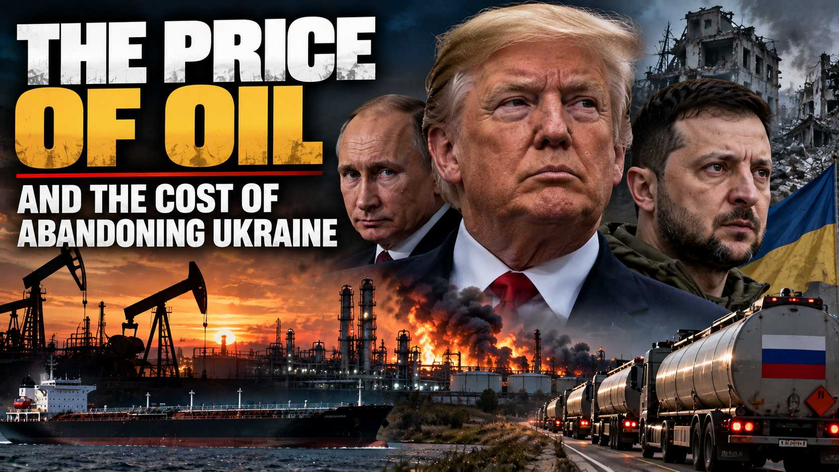







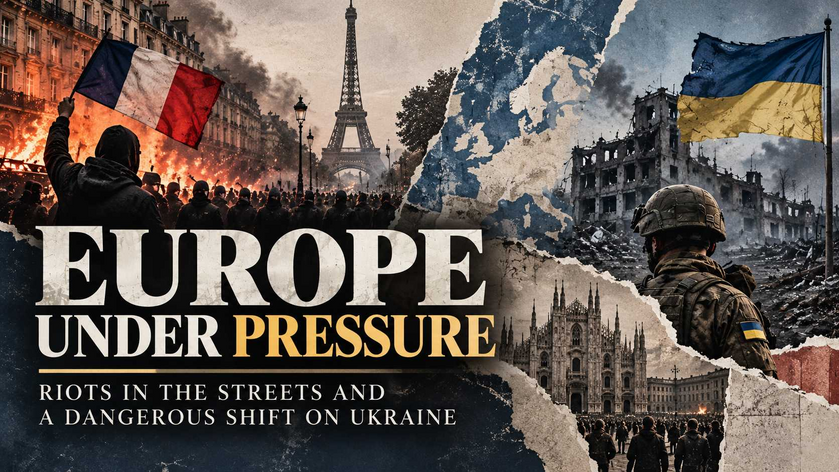
As unrest spreads across parts of Europe, Washington's approach to Russia is raising new concerns about Ukraine's future and the West's ability to confront growing security threats.
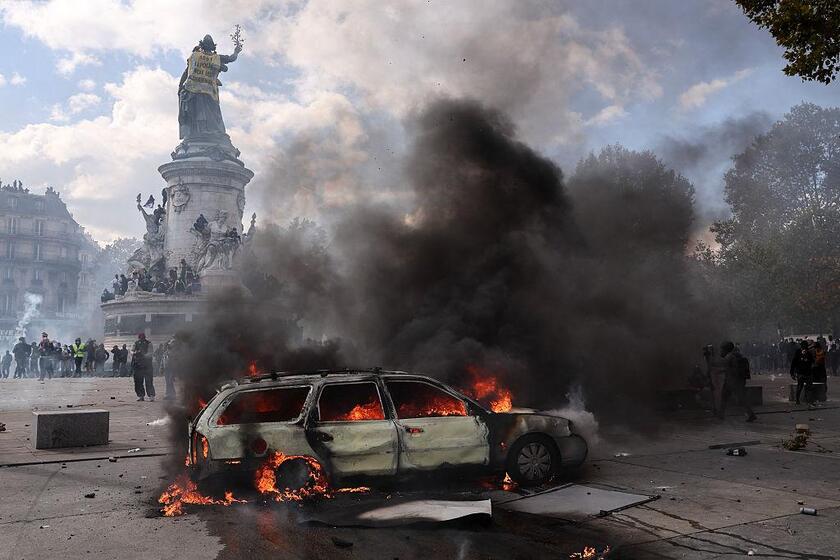
A car burns at Place de la République in Paris on October 17, 2026, as demonstrations over rising living costs escalate into clashes between protesters and police. Nearly 2,400 people were arrested across France during the unrest.
Photo: Thibault Camus / Associated Press
Europe is facing two serious challenges that raise important questions about political leadership, public security and the future of Western stability. In France and Italy, reports of violent demonstrations, attacks on police officers and widespread property damage have intensified concerns about public order. Meanwhile, Ukraine continues defending itself against Russia's invasion while facing increasing pressure from Washington over its attacks on Russian energy infrastructure.
During my latest Hot Zone broadcast, I examined footage of the unrest in Europe and President Donald Trump's recent statements about Russia and Ukraine. Although these crises are different, both illustrate the consequences of governments attempting to manage immediate political pressures without adequately addressing the underlying problems.
Having spent much of my career reporting from conflict zones, I've seen how quickly instability can escalate when authorities struggle to maintain order. I've also recently returned from Ukraine, where the human cost of Russia's invasion remains painfully evident.
France and Italy Confront Violent Unrest
The footage circulating from France is deeply troubling. Groups of rioters can be seen throwing rocks, bottles and other objects at police vehicles, while officers attempt to defend themselves against sustained attacks. Other recordings appear to show businesses being looted, storefronts damaged and public property set on fire.
According to figures discussed during the broadcast, more than 2,400 people had reportedly been arrested during a weekend of unrest, with over 600 police officers injured. Those numbers require independent confirmation, but the footage illustrates the serious challenges facing French law enforcement.
Similar scenes have reportedly emerged from Milan, Italy, where videos show groups damaging storefronts and individuals confronting suspected looters.
Milan is a city my wife and I have visited many times, and it remains one of our favorite destinations in Europe. Its architecture, history and proximity to Lake Como make it a remarkable place. Seeing reports of destruction in such a beautiful city is particularly disturbing.
There is an important distinction between peaceful protest and criminal violence. Citizens have every right to criticize their governments and demand political change, but attacking police officers, destroying businesses and setting buildings on fire cannot be justified as legitimate political expression.
One especially troubling report involved a fire at a historic municipal building in Limoges, France. The structure was described during the broadcast as a nineteenth-century landmark that had served the community for generations. The extent of the damage and circumstances surrounding the fire still require verification, but the destruction of historic public buildings represents a loss that extends far beyond their monetary value.
These institutions reflect generations of work and investment. Destroying them does nothing to improve the conditions that demonstrators claim to oppose.
A Growing Challenge for European Leaders
French President Emmanuel Macron has reportedly promised a firm response to the violence, emphasizing that those responsible for criminal acts will face consequences.
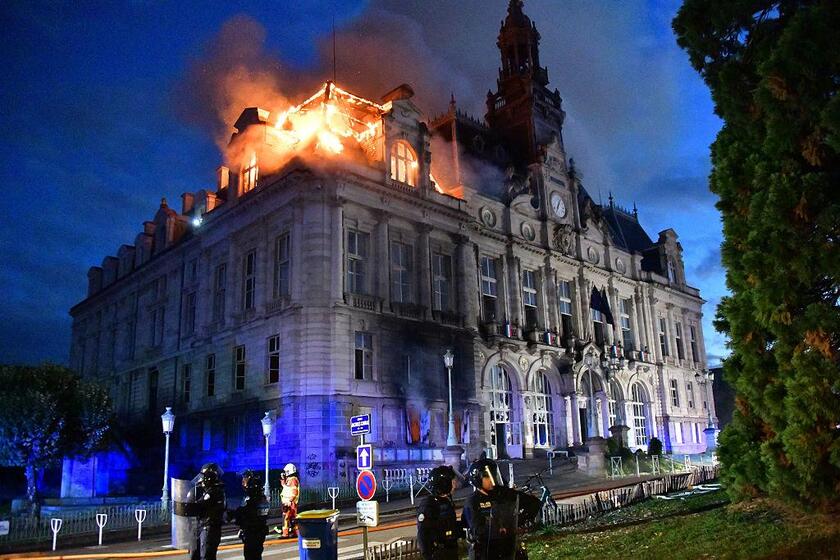
Fire engulfs the historic town hall in Limoges, France, during nationwide demonstrations on October 17, 2026. The nineteenth-century building suffered extensive damage after a group set it ablaze amid the unrest.
Photo: Pascal Lachenaud / AFP
The difficulty is that restoring order requires more than political statements. Police must protect businesses, public buildings and cultural institutions while distinguishing peaceful demonstrators from individuals engaged in violence.
The unrest has also renewed debate about immigration, integration and the influence of extremist political movements in Europe. I raised concerns during the broadcast about the possibility that radical organizations could exploit demonstrations for their own political objectives.
However, claims that particular organizations are financing or coordinating the violence require evidence, and the appearance or ethnic background of individuals in protest footage cannot establish their immigration status or political affiliations.
The legitimate questions are serious enough without speculation. European governments must examine whether their integration policies are effective, whether security services have sufficient resources and whether the law is being enforced consistently.
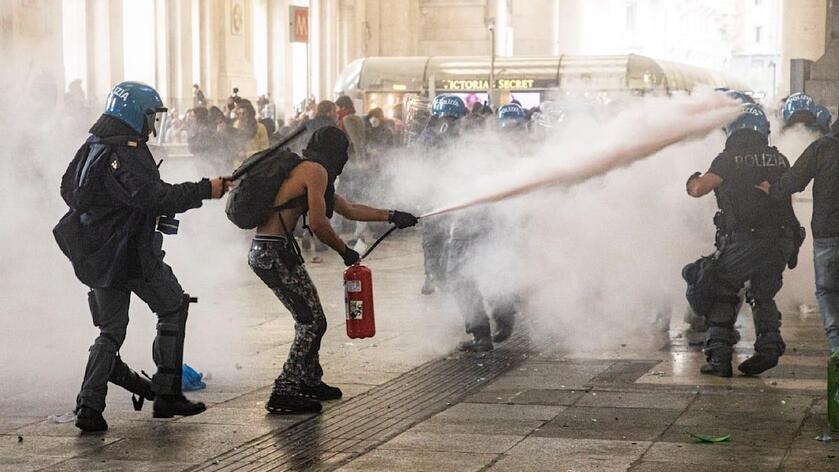
Italian police deploy a water cannon during demonstrations over rising living costs and public services in Milan on October 18, 2026. Clashes between protesters and police were accompanied by looting and damage to businesses in the city center.
Photo: Reuters / Stringer
These concerns are also shaping France's political future, with Marine Le Pen and other nationalist figures continuing to attract support among voters dissatisfied with the country's direction.
While I understand many of the concerns driving that movement, I have serious reservations about political leaders whose approach to Russia and Ukraine appears insufficiently critical of Moscow's aggression.
Trump's Approach to Russia Raises Questions
President Trump's recent statements about Russia have raised similar concerns.
According to the developments discussed during my broadcast, the administration has moved toward easing certain restrictions affecting Russian energy exports while attempting to reduce international diesel prices.
Trump defended his approach by arguing that additional pressure on Moscow could interfere with negotiations intended to end the war.
"My decision on Russia is a very simple one. I'm in the process of negotiating peace in the war between Russia and Ukraine, and I don't want to do anything that will drive foolishly Russia away from the bargaining table," the president said in remarks quoted during the broadcast.
Ending the war is a worthy objective, but negotiations become more difficult when one side receives concessions before demonstrating any willingness to compromise.
If Washington reduces economic pressure on Russia without securing meaningful commitments in return, Moscow may conclude that prolonging the conflict is more advantageous than negotiating seriously.
The precise scope of the reported sanctions relief requires verification against official government announcements. Nevertheless, the strategic concern remains: diplomatic concessions should produce measurable results rather than simply encourage promises of future discussions.
Ukraine Must Have a Voice in Its Own Future
During the broadcast, I also discussed reports that Russian President Vladimir Putin had expressed interest in talks involving Russia, China and the United States.
The obvious concern is whether Ukraine would be included in those negotiations.
Any agreement intended to end Russia's invasion must involve the country whose territory has been occupied and whose citizens continue to bear the consequences of the war.
I've traveled through Ukraine and spoken with people whose lives have been devastated by the fighting. Their concerns are not theoretical. They want to know whether their families will be safe, whether their communities can be rebuilt and whether Russia would simply use a ceasefire to prepare for another offensive.
Those questions cannot be resolved by allowing larger powers to determine Ukraine's future without its meaningful participation.
China's potential role also deserves scrutiny. Beijing maintains significant economic ties with Moscow, and Russia's increasing dependence on Chinese markets and industrial supplies has strengthened China's influence. Any diplomatic arrangement must account for those interests.
Ukraine Continues Striking Russian Energy Infrastructure
While political leaders debate negotiations, Ukraine is continuing its campaign against Russian military and economic infrastructure.
Ukrainian forces have increasingly used long-range drones to target refineries, petroleum facilities and other installations connected to Russia's war economy.
During the broadcast, I discussed reports of strikes near St. Petersburg and claims of Ukrainian advances around Lyman and Kupiansk. The precise scale of those operations and the territorial changes require independent confirmation, but Ukraine's broader strategy is evident.
By attacking infrastructure supporting Russia's military operations, Kyiv is attempting to disrupt fuel supplies, impose economic costs and force Moscow to devote additional resources to protecting facilities far from the front lines.
The war's future also depends heavily on the situation in Donetsk, where Russia continues demanding control of territory that Ukraine considers essential to its defenses.
Secretary of State Marco Rubio, in remarks played during the broadcast, explained that Ukrainian defensive positions in the remaining Ukrainian-held areas of Donetsk are strategically important. Surrendering those positions without reliable security guarantees could leave Ukraine exposed to renewed Russian attacks.
Ukraine faces serious manpower shortages, exhausted military units and continued pressure along the front. Nevertheless, it would be a mistake to assume that Kyiv has no negotiating leverage simply because the conflict has lasted longer than anticipated.
Republicans Question the Administration's Decision
Criticism of Trump's approach is also coming from within his own party.
During the broadcast, I played remarks from Republican Senator Ted Cruz, who questioned the administration's reported easing of sanctions affecting Russia.
"I wish the president hadn't done it. I think it was a mistake," Cruz said.
Cruz acknowledged the administration's legitimate concern about fuel prices but argued that other approaches should be considered before providing economic relief to Moscow.
That distinction matters.
Americans are understandably concerned about gasoline and diesel prices, but international energy costs are influenced by many factors, including shipping disruptions, refinery capacity and instability in the Persian Gulf.
During the broadcast, I examined an argument that the sharp increase in diesel prices was more closely associated with disruptions to Gulf shipping than with Ukraine's attacks on Russian refineries. The comparison does not establish the full cause of the price increase, but it raises reasonable questions about efforts to place responsibility on Kyiv.
Blaming Ukraine for a broader international energy crisis risks overlooking Russia's responsibility for starting the war.
The Consequences of Short-Term Thinking
The unrest in Western Europe and the war in Ukraine require different responses, but both demonstrate the importance of principled leadership.
European governments must restore public order while protecting peaceful protest and ensuring that criminal violence is addressed through lawful enforcement.
The United States, meanwhile, must pursue an end to the war in Ukraine without strengthening Russia's ability to continue its invasion or undermining Ukraine's long-term security.
I have supported President Trump politically, and I want his administration to succeed. But supporting a president does not require agreeing with every decision, particularly when those decisions have serious consequences for countries fighting to preserve their independence.
Lower fuel prices are important, and ending the war would be an enormous achievement. But neither objective should be pursued without considering the longer-term costs.
Ultimately, Europe's future will depend on whether its leaders can maintain security, defend their institutions and make decisions based on lasting strategic interests rather than immediate political convenience.