





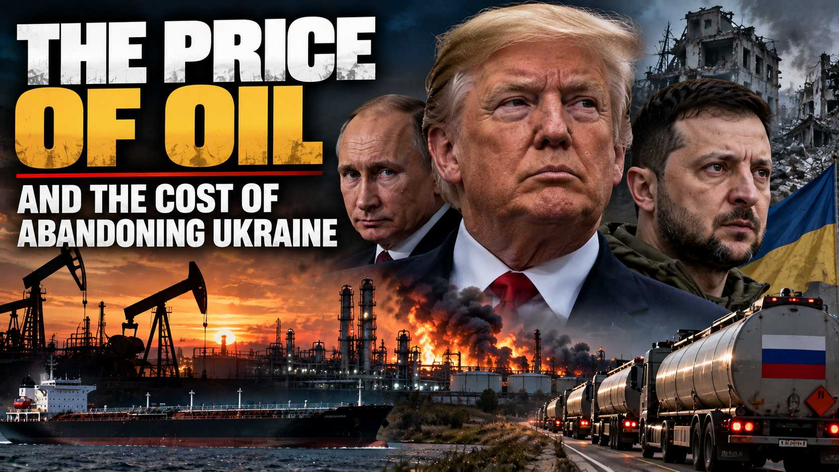
As war in the Middle East drives up fuel prices, President Trump is turning his frustration toward Ukraine's attacks on Russian energy infrastructure. But blaming Kyiv for a global energy crisis risks rewarding the very country that started the war.
With oil prices climbing, shipping routes under attack and the conflict in the Middle East showing little sign of ending, President Donald Trump is facing an increasingly difficult political and economic problem. Americans are paying more for fuel, global energy markets remain unsettled, and the administration is searching for ways to bring prices down before the midterm elections.
Unfortunately, one of the president's answers appears to be putting additional pressure on Ukraine, a country that is fighting for its survival against a Russian invasion.
During my latest broadcast, I examined Trump's criticism of Ukrainian attacks on Russian oil refineries, his reported agreement to bring Russian diesel back onto the international market, and his announcement of a ceasefire that neither Moscow nor Kyiv appeared prepared to observe. Taken together, these developments raise serious questions about American foreign policy and the consequences of treating an invaded country as an obstacle to lower fuel prices.
I have supported President Trump in three elections, and I have never believed that supporting a president requires defending every decision he makes. When an administration gets something right, it deserves recognition. When it makes a serious mistake, particularly one with consequences for American security and the survival of an allied nation, it deserves scrutiny.
What troubles me about this situation is that Ukraine is being blamed for economic consequences arising from a much larger war, while Russia stands to benefit from the administration's proposed solution.
A Deadly Strike in Saudi Arabia Adds to the Pressure
The immediate backdrop to this dispute is the rapidly deteriorating security situation in the Middle East.
Over the weekend, a missile strike attributed to Yemen's Houthi movement reportedly hit the international airport in Riyadh, Saudi Arabia, killing 13 people, including an American citizen. According to the reports I reviewed during the broadcast, the airport had been targeted twice within approximately 48 hours, raising questions about how incoming weapons penetrated Saudi Arabia's extensive air-defense network.
I have traveled through Riyadh's airport many times and have seen the sophisticated defensive systems deployed around the facility. Saudi Arabia operates Patriot missile batteries and other air-defense assets, making the reported success of these strikes particularly concerning.
The attack reportedly involved more than a single incoming missile. The account I discussed described an initial wave of drones followed by cruise and ballistic missiles, creating several simultaneous threats with different speeds, flight paths and radar signatures.
Such attacks are designed to complicate the work of air-defense crews. Low-flying cruise missiles can be difficult to detect against terrain, while ballistic missiles approach at much higher speeds. When multiple weapons arrive within a short period, defenders must identify, prioritize and engage each threat before it reaches its target.
The exact composition of the attack and the reasons for the apparent defensive failure require independent confirmation. Nevertheless, the reported casualties illustrate the danger posed by Iran-aligned armed groups to critical infrastructure across the region.
The death of an American citizen also places additional pressure on Washington to respond. Any substantial American military action against the Houthis could expand an already dangerous regional conflict.
The Strait of Hormuz Remains Under Threat
At the same time, commercial shipping through the Strait of Hormuz continues to face attacks and disruptions.
During the broadcast, I reviewed maritime incident reports describing repeated attacks and suspected attacks against vessels operating near the strait during the first week of October. The frequency of these incidents demonstrates the difficulty of maintaining normal commercial activity through one of the world's most important energy corridors.
The Strait of Hormuz connects the Persian Gulf to the Gulf of Oman and the wider international shipping network. A substantial portion of the world's seaborne petroleum trade normally passes through this narrow waterway, making any sustained disruption a matter of global economic concern.
According to the operational picture discussed in the broadcast, some shipments are continuing through alternative arrangements, including the use of smaller vessels and transfers farther out in the Gulf of Oman. Those arrangements may help preserve some supply, but they cannot eliminate the risks, delays and additional costs associated with operating in a contested maritime environment.
I also discussed footage circulated in connection with alleged attacks on commercial ships. Some of that material was presented as evidence of sea mines, although the visible explosions raised questions about whether the weapons shown actually matched those descriptions.
This is one of the recurring difficulties in reporting on modern warfare. Old footage is frequently republished as new, images are stripped of their original context, and increasingly convincing AI-generated videos circulate alongside authentic recordings. Without reliable information about where and when an incident occurred, dramatic footage can easily become a vehicle for misinformation.
The economic consequences, however, are not confined to the information war. Higher shipping risks, interrupted petroleum supplies and uncertainty about future attacks all contribute to volatility in international energy markets.
During the broadcast, I discussed reports of Brent crude briefly reaching approximately $149 per barrel before retreating toward $106. Those figures should be checked against historical market data before being treated as confirmed benchmarks, but the larger concern is clear: prolonged disruption to Gulf shipping can have consequences far beyond the Middle East.
That is the environment in which President Trump is attempting to reduce American fuel prices.
Why Ukraine Is Attacking Russian Refineries
Ukraine's attacks on Russian energy infrastructure are not a new development.
For more than a year, Ukrainian forces have used increasingly sophisticated long-range drones to target Russian oil refineries, fuel depots and other facilities supporting Moscow's war effort. These operations are intended to disrupt the supply of fuel used by Russian military forces and to impose economic costs on the country that invaded Ukraine.
There is a military logic behind that strategy.
Armies depend on fuel to move tanks, trucks, artillery systems and supplies. Russia's military operations also rely on an enormous transportation and logistics network, much of which ultimately depends on petroleum products. Disrupting refining capacity can complicate those operations while forcing Moscow to devote additional resources to protecting and repairing industrial facilities.
Ukraine does not possess the same conventional military resources as Russia, and it has been forced to develop innovative methods of striking targets far behind enemy lines. Its long-range drone campaign has become one of the most consequential examples of how relatively inexpensive unmanned systems can threaten infrastructure once considered difficult to reach.
Trump, however, has publicly criticized these attacks, arguing that they contribute to international fuel shortages and harm American farmers and other consumers who depend on diesel.
In the remarks played during my broadcast, the president said:
"You can do whatever you want to Russia. Don't hit the refineries because that's a world problem."
He went on to accuse Ukrainian President Volodymyr Zelenskyy of creating problems for the rest of the world and warned that attacks on refineries needed to stop.
The problem with this argument is that it shifts attention away from the country responsible for launching the invasion.
Russia invaded Ukraine. Russia has repeatedly attacked Ukrainian cities, power plants and civilian infrastructure. Ukraine's strikes against Russian fuel production are part of its effort to weaken the military machine responsible for those attacks.
There is a legitimate economic debate about how damage to Russian refineries affects global petroleum markets. Energy prices are shaped by many factors, including production, refining capacity, transportation, sanctions and expectations about future supply. But it is misleading to treat Ukrainian attacks as though they are the sole or primary explanation for a crisis unfolding amid major disruptions in the Persian Gulf.
More importantly, Ukraine cannot reasonably be expected to preserve Russia's ability to sustain its invasion simply because the consequences of the war have become inconvenient for other countries.
A Russian Diesel Deal Raises Difficult Questions
The administration's reported effort to bring additional Russian diesel onto the international market adds another dimension to the controversy.
According to the account discussed during the broadcast, Trump reached an arrangement intended to encourage Russia to resume exporting significant quantities of diesel fuel. The administration's apparent objective is to increase global supply and reduce pressure on prices.
That goal is understandable. Lower fuel prices would benefit American consumers, businesses, farmers and transportation companies.
But the source of the fuel matters.
Russia's energy sector remains an important source of revenue for the government financing its invasion of Ukraine. Any agreement that increases Moscow's export earnings should be examined not only for its potential effect on fuel prices but also for the resources it could provide to Russia's military campaign.
Military analyst Ryan McBeth raised that concern in a video I referenced during the broadcast.
"Do we want to sell our souls to Russia for about 11 days' worth of diesel?"
McBeth's comparison was intended to illustrate the limited potential benefit of the proposed supply increase relative to the strategic and moral costs of dealing with Moscow.
The precise volume of diesel involved, the terms of the reported agreement and the calculation behind that comparison require independent verification. But the underlying policy question remains important: how much additional revenue should the United States be willing to help Russia generate in pursuit of lower fuel prices?
There is another allegation that deserves particular scrutiny.
During the broadcast, I discussed reports and images suggesting that Iranian diesel was being transported into Russia, potentially allowing Moscow to sell fuel originating in Iran. If such transactions are occurring in connection with the proposed arrangement, they could create an additional concern by indirectly benefiting Tehran.
The material presented during the broadcast does not establish the origin of diesel intended for any American purchase, and the allegation should not be treated as proven without shipping records, commercial documentation or other corroborating evidence.
Nevertheless, the possibility illustrates why energy agreements involving sanctioned or adversarial governments demand careful examination.
An arrangement intended to relieve economic pressure at home could have significant consequences abroad.
A Ceasefire Announcement Without a Ceasefire
The controversy deepened when Trump announced what he described as an agreement between Russia and Ukraine to stop attacking energy infrastructure.
According to the account presented during my broadcast, the announcement appeared on Truth Social despite no clear indication that the two governments had reached a binding agreement.
Shortly afterward, reports emerged of additional Russian attacks against Ukrainian energy infrastructure and civilian areas.
I reviewed footage of one reported strike showing an explosion near civilians on a city street. The images were disturbing, although the precise location, casualties and circumstances of the incident require verification before definitive conclusions can be drawn from the recording.
The central diplomatic issue is whether a ceasefire actually exists.
A ceasefire requires the parties involved to accept and implement specific terms. Announcing that fighting should stop is not the same as securing an agreement that the combatants intend to honor.
This distinction matters particularly in Ukraine, where repeated negotiations and proposed pauses in fighting have failed to produce a lasting end to hostilities.
If Russia continues striking Ukrainian energy infrastructure while Ukraine is pressured to halt its attacks on Russian refineries, the result would not be a balanced arrangement. It would leave Moscow free to damage Ukraine's economy and civilian infrastructure while restricting Kyiv's ability to retaliate against the facilities supporting Russia's war effort.
Zelenskyy addressed that imbalance directly in remarks played during the broadcast.
"If they want energy ceasefire, we are open for this. Don't attack us. Don't kill our children. We will stop attack your diesel."
That is a fundamentally different proposition from demanding that Ukraine stop striking Russian targets while Russian attacks continue.
It offers reciprocal restraint rather than unilateral concessions.
The Demand for Ukrainian Elections
Trump has also renewed calls for elections in Ukraine, suggesting that a change in leadership could help bring the war to an end.
The difficulty is that Ukraine remains under martial law, with large parts of the country exposed to Russian attacks and millions of citizens displaced or living under occupation.
Conducting a credible national election under those circumstances would be an enormous logistical and security challenge.
How would soldiers serving along the front lines participate? How would polling stations operate in communities vulnerable to missile and drone attacks? What arrangements would be made for Ukrainians living abroad, and how could citizens in Russian-occupied territories exercise their voting rights?
These are not minor administrative details. They go directly to whether an election could be considered free, fair and representative of the Ukrainian population.
Ukrainian law also restricts national elections during martial law, meaning the issue cannot simply be resolved by a presidential announcement.
During the broadcast, I discussed Zelenskyy's reported willingness to consider elections if a sufficiently secure ceasefire could be established, including a proposed 60-day period without fighting.
Such a proposal would require significant security guarantees and legal preparations. The transcript does not establish that Russia has accepted those conditions.
The broader concern is that calls for immediate elections can become another form of pressure on Ukraine's leadership without addressing the underlying problem: Russia's continuing invasion.
The Debate Over Ukraine Reaches American Television
The dispute has also exposed sharp disagreements within American conservative media.
During a segment of Fox & Friends reviewed in my broadcast, one host suggested that Ukraine's attacks on Russian refineries were undermining Trump's efforts to reduce fuel prices and reach a peace agreement.
Brian Kilmeade challenged that argument, emphasizing Russia's responsibility for beginning the war.
"There is no way Zelenskyy turned down any plausible deal."
Kilmeade went on to argue that Russian President Vladimir Putin bears responsibility for the conflict and that Ukrainian attacks on facilities supporting Russia's military should be understood in that context.
His argument reflects a distinction that is frequently lost in political discussions about the war.
There is a difference between wanting the fighting to end and expecting the invaded country to accept whatever terms its attacker demands.
A peace agreement that leaves Ukraine unable to defend itself or permits Russia to resume aggression after rebuilding its forces may stop the immediate fighting without producing lasting security.
Likewise, criticizing the conduct of Ukraine's government does not require accepting Moscow's explanation for the invasion.
I have spent years reporting from conflict zones, and one lesson has remained consistent: the terms under which a war ends are often just as important as the moment the shooting stops.
Supporting a President Does Not Mean Ignoring His Mistakes
During the broadcast, I made clear that my criticism of Trump comes from a position of having supported him politically.
I voted for him three times. I want American policy to succeed, and I recognize the difficult decisions facing any president attempting to manage several international crises while protecting the American economy.
But loyalty to a political leader cannot replace independent judgment.
When I believe the president is misrepresenting Ukraine's position or placing unreasonable demands on a country defending itself against invasion, I have an obligation to say so.
As I explained during the broadcast:
"We cannot accept that from our leaders."
That principle should apply regardless of which political party occupies the White House.
The United States has legitimate reasons to be concerned about rising fuel prices, the security of international shipping and the economic consequences of prolonged conflict. American officials also have a responsibility to pursue diplomatic opportunities that could bring the war in Ukraine to an end.
But those objectives must be weighed against the danger of strengthening Russia economically while weakening Ukraine militarily.
A policy that reduces diesel prices temporarily but makes it easier for Moscow to continue its invasion may prove extraordinarily expensive in the long run.
The Real Cost of Short-Term Decisions
The conflicts in Ukraine and the Middle East are increasingly connected through energy markets, military assistance and international diplomacy.
Attacks on shipping near the Strait of Hormuz affect the global supply of petroleum. Russian refineries and fuel exports influence Moscow's ability to sustain its war. Iran's relationships with armed groups across the Middle East complicate regional security, while the United States faces pressure to protect both its economic interests and its international commitments.
These issues cannot be solved by treating each new development as an isolated problem.
Lower fuel prices are important, but so is preventing adversarial governments from using energy revenue to finance aggression. Ending the war in Ukraine is desirable, but an agreement that rewards invasion could create conditions for future conflicts.
The administration must consider the second- and third-order consequences of its decisions rather than focusing exclusively on their immediate political appeal.
For Ukraine, the stakes are existential. Its people are not fighting over an abstract diplomatic disagreement or a temporary dispute about fuel prices. They are fighting to preserve their independence, territory and national identity.
Zelenskyy's offer to stop attacks on Russian energy facilities in exchange for an end to Russian attacks on Ukraine deserves serious consideration. It provides a basis for discussing reciprocal restraint without requiring one side to surrender its right to defend itself.
Whether Moscow is willing to accept such an arrangement is another matter.
Ultimately, the question facing Washington is not simply how to reduce the price of diesel before an election. It is whether the United States can pursue economic stability without compromising the principles and security interests that have shaped its response to Russia's invasion.
There is nothing wrong with wanting cheaper fuel. Every American family and business would benefit from relief at the pump.
But if that relief comes at the expense of a country struggling to survive an unprovoked invasion, we need to ask whether the price is really worth paying.