From yesterday*
I appreciate all of you supporting the hot zone. Thank you for being here.
How do you think this is all going to end?
If you have wondered why Russia is losing so many men and Ukraine is not, this will help explain it. Russia is sending men into the front lines where they are killed by drone operators from Ukraine who are hundreds of miles away from the front lines.
When we faithfully endure tribulations, we will experience God's provision, power and intervention, by which we'll be shaped increasingly into Christ's image, and also, this will further solidify our hope and confidence in God's promises. For since we've experienced His faithfulness in the midst of our sufferings, we will increasingly, joyfully and excitedly anticipate the fulfillment of all that is written in Scripture!
"Not only that, but we rejoice in our sufferings, knowing that suffering produces endurance, and endurance produces character, and character produces hope." (Romans 5:3-4)
“LIVE: Iran State TV Threaten To Assassinate Tousi TV - U.S. Launch Strikes On IRGC” Tousi TV YouTube
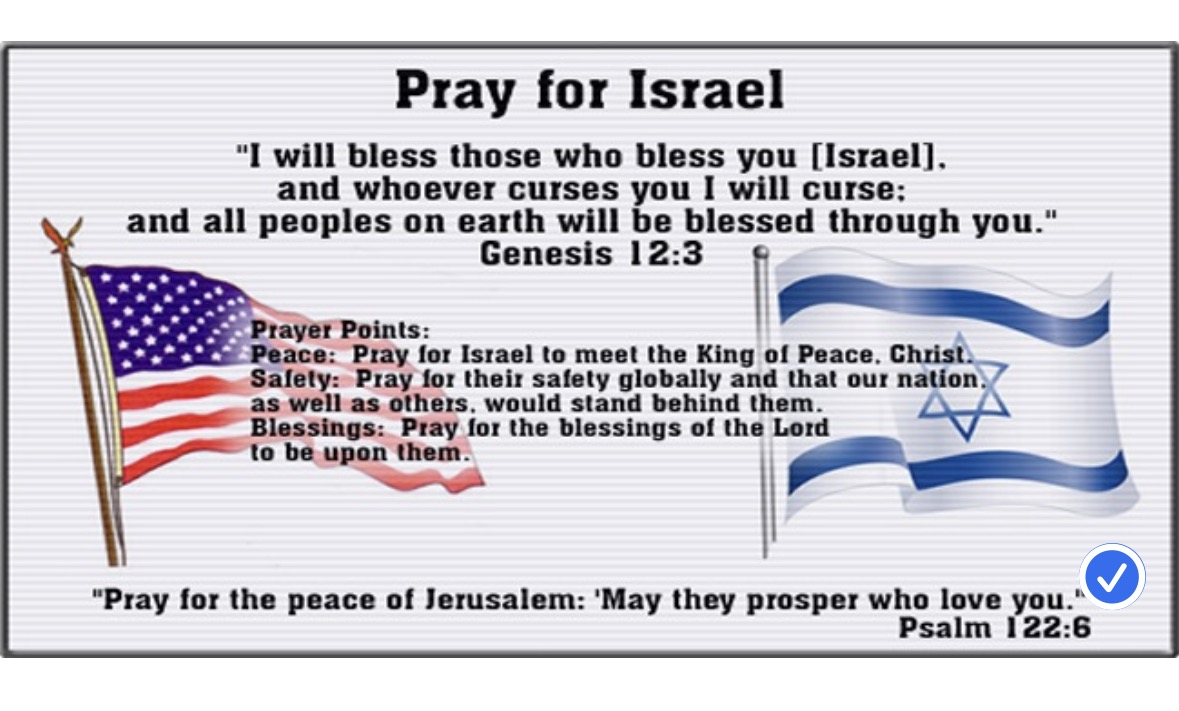
"For they were pleased to do it, and indeed they owe it to them. For if the Gentiles (or the nations) have come to share in their spiritual blessings (Israel's), they ought also to be of service to them in material blessings."(Romans 15:27)
The Church has not replaced Israel, as some erroneously teach to their own detriment, but through the Gospel we have come to share in their spiritual blessings. We've been grafted into them, the "natural olive tree," though we are a wild one, as the Apostle Paul communicated in Romans 11:17-24. For by the blood of Christ, we have been brought near, into the very "commonwealth" of Israel, as we read here - Ephesians 2:11-13,19. So now, we are not without God, nor without hope, because we've been made beneficiaries and partakers of the covenants of promise, those given to the Jewish people. As it is written, in Christ every promise of God is yes and amen in Him (2 Corinthians 1:20).
And O the blessings that await us (the Church), when Israel finally gets right...
For months, the central question surrounding Iran has been whether the regime can withstand the economic and military pressure being applied by the United States and its allies.
This week, a different question emerged.
What if Iran is already getting what it wants?
President Trump continues to insist that Iran cannot be allowed to obtain a nuclear weapon. During a rare televised cabinet meeting, he pointed to Iran's economic collapse, soaring inflation, and internal instability as evidence that Tehran has little choice but to negotiate. According to Trump, Iran's leadership is feeling the pressure.
The problem is that pressure alone does not guarantee results.
Recent reports out of Iran claimed that negotiators were discussing a framework that would effectively grant Tehran greater influence over the Strait of Hormuz while postponing any serious discussion of its nuclear program. The White House has since dismissed those reports as false, but the episode exposed a growing concern among regional observers.
Negotiations appear to be moving slowly, while events on the ground continue moving in Iran's favor.
At the center of the debate is the Strait of Hormuz.
Roughly one-fifth of the world's oil supply normally passes through this narrow waterway. Whoever controls access to it holds significant leverage over global energy markets.
Before the conflict escalated, Iran did not possess the level of influence over shipping traffic that it does today. Now, according to several military analysts, Tehran has demonstrated an ability to disrupt one of the world's most important commercial chokepoints.
That reality is shaping every negotiation.
Retired General Jack Keane warned that Iran views control of the Strait as a strategic prize and has little incentive to surrender that leverage voluntarily. Gulf Arab states are watching closely. Their economies depend on stable energy exports, and many are increasingly uncertain about how the current negotiations will end.
The longer uncertainty continues, the more regional governments may begin making their own accommodations with Tehran.
Former CENTCOM Commander General Joseph Votel offered another important perspective.
Military action can weaken Iran. It can destroy infrastructure, degrade capabilities, and impose costs. But military force alone is unlikely to produce a lasting solution.
While most Americans were grilling burgers, watching baseball, or trying not to think about geopolitics for five minutes, the United States quietly carried out a major counterterrorism operation in Nigeria—and at the same time, all signs point to President Trump preparing for another possible strike on Iran. Those two stories may seem unrelated.
They’re not. They tell us a lot about where American foreign policy is headed, how terrorism has evolved, and why the Middle East may be far from finished exploding.
If you missed the LIVE, you can watch it HERE
President Trump announced that U.S. special operations forces, working alongside Nigerian forces, eliminated Abu Bal al-Minuki—the number two global leader of ISIS.
Or as I jokingly call them on YouTube so I don’t get demonetized: the “Black Pajama Boys.”
Now before you shrug this off as another headline from some faraway place most Americans can’t find on a map, understand what this means. ISIS never really disappeared. We destroyed their caliphate during the first Trump administration. We crushed their territorial control in Syria and Iraq. But the organization itself survived. The brand survived. And now the center of gravity for ISIS activity has shifted into Africa.
That’s where the war is.
Most Americans still think of terrorism through the lens of Iraq and Afghanistan. That’s outdated thinking. Today, the majority of ISIS activity is concentrated across parts of Africa—especially Nigeria and the surrounding region. And the violence there is horrific. Last year alone, more than 3,600 Christians were murdered in Nigeria.
Three thousand six hundred people slaughtered largely because of their faith. Some of that violence comes from ISIS-linked groups. Much of it comes from radicalized Fulani militants who attack Christian villages, burn homes, seize farmland, and massacre civilians. I’ve been to Nigeria. I’ve seen the fear people live under there. And while the world’s media obsesses over American politics 24 hours a day, entire Christian communities are being erased in parts of Africa with barely a mention.
There’s a growing mindset in America that says:
“America First means America Only.”
I disagree. If we have the ability to stop terrorists before they spread globally, we should do it. Not because we’re the world’s babysitter. But because history shows that when terrorists are allowed to build safe havens overseas, eventually Americans die too. That’s not theory. That’s exactly what happened before 9/11. And ISIS has adapted. Instead of focusing solely on controlling territory, they’re now investing heavily in online radicalization.
They recruit lone wolves.
They inspire attacks remotely.
They spread propaganda globally.
That means the battlefield isn’t just Nigeria anymore. It’s your phone.
At the same time all this is happening, the Iran situation is getting more dangerous by the day. President Trump openly admitted that negotiations with Iran keep collapsing because Tehran repeatedly agrees to terms… and then pretends the conversation never happened. That’s because Iran was never negotiating in good faith to begin with. They’re stalling. Trying to preserve their nuclear capability while avoiding another American strike.
And meanwhile, the regime is preparing its own population for possible war. Iran reportedly sent text messages asking citizens whether they’d be willing to “martyr themselves for the regime.” Think about how insane that is. At the same time, Iranian state television has literally been airing AK-47 training sessions for civilians—although judging by the footage, some of these guys shouldn’t be trusted with a Nerf gun. One instructor accidentally fired a round through the ceiling of the studio during a live demonstration.
Funny? Sure. Also revealing. Because it tells you the regime is nervous.
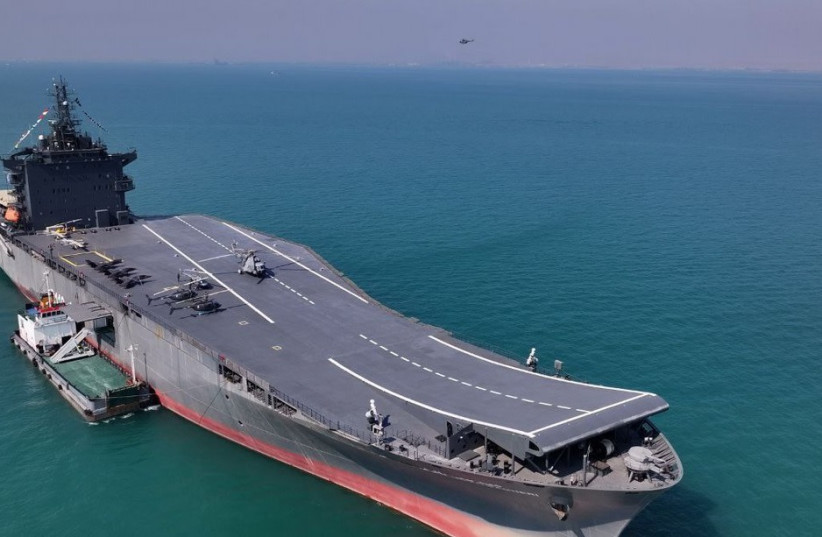
A lot of people think this conflict is mainly about nuclear weapons. It’s not. The real issue is control of the Strait of Hormuz—the narrow waterway through which a huge percentage of the world’s oil flows. Iran wants control over it. The rest of the world cannot allow that. That’s why the U.S. still has major naval forces positioned in the region right now, even after the ceasefire. And according to multiple reports, additional military strikes could happen as soon as this week.
What we’re watching right now is a transition. America appears to be moving back toward aggressive counterterrorism operations overseas while simultaneously preparing for the possibility of a larger regional conflict with Iran. And unlike the endless nation-building experiments of the past, these operations are increasingly:
That’s the future of warfare. But it also means the world is becoming more unstable—not less.
Here’s the reality nobody wants to admit:
The bad guys never stopped organizing.
ISIS adapted.
Iran stalled.
China maneuvered.
Russia escalated.
Terror groups spread into Africa.
And the world kept pretending everything was returning to normal.
It isn’t. The question isn’t whether America should engage with threats overseas. The question is whether we deal with them there… or wait until they show up here. Because history has already answered that question once. And it cost us thousands of lives.
Stay alert. Stay informed. And as always—keep your head on a swivel.
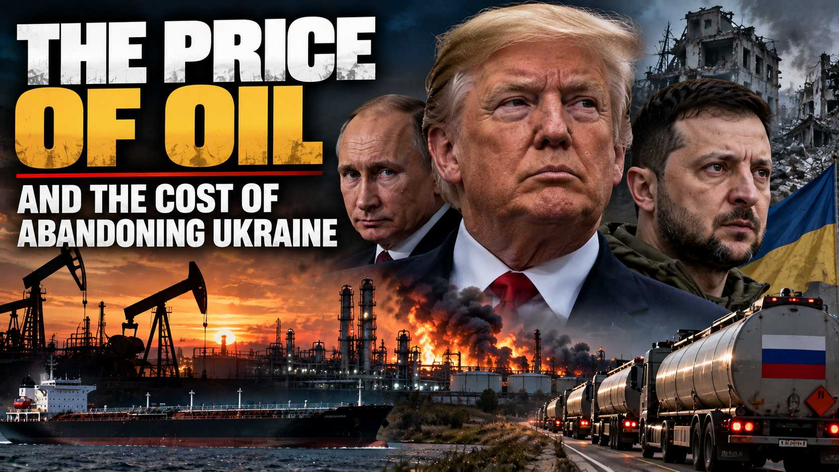
I don’t talk about Ukraine as much as I used to. Not because it’s not important—but because a lot of people have tuned it out. It’s been going on long enough that it’s faded into the background noise for most Americans. That’s a mistake. Because what’s happening in Ukraine right now is a preview of the future of warfare—and it has direct implications for U.S. national security.
Let me explain.
(If you missed the LIVE, you can watch it HERE )
Russia just launched one of the largest aerial assaults of the entire war—over 1,500 drones and missiles in about a 30-hour period.
Think about that for a second. Thirty straight hours of air raid sirens. Explosions. Families hiding in basements. Kids wondering if their apartment building is next. And here’s the part that matters most: these weren’t primarily military targets. Russia is targeting civilians—apartment buildings, infrastructure, everyday people. That’s not accidental. It’s intentional. It’s terrorism as strategy.
I’ve stood in the rubble of those buildings. I’ve seen what’s left behind. One image that still sticks with me is a little girl’s pet turtle—blown out of an apartment after a missile strike, painted toenails and all. They never found the girl. That’s what this war looks like on the ground.
Now contrast that with how Ukraine is fighting. While Russia is hitting civilians, Ukraine is targeting oil refineries, aircraft, radar systems—military infrastructure that actually affects the war effort. That difference matters. Ukraine isn’t trying to terrorize the Russian population. They’re trying to degrade Russia’s ability to wage war. That’s the difference between a military campaign and a campaign of intimidation. And it’s one of the reasons Ukrainian morale is holding strong—even under constant attack.
If you want to understand where warfare is heading, don’t look at tanks. Look at drones. Ukraine is now operating at a level that frankly should concern every military planner in the United States. They’ve figured out how to:
We’re talking about unmanned ground vehicles evacuating wounded soldiers. Armed robotic systems holding defensive positions. Drone boats launching missiles and aerial drones from the sea. At one point, a single unmanned ground vehicle reportedly held off a Russian unit for over a month.
And here’s the uncomfortable truth: the United States is behind in this area. We’re now sending personnel to learn from the Ukrainians.
Despite the massive attacks, Russia is not winning this war. They’re losing soldiers at a staggering rate—far faster than they can replace them. And that matters long-term. Wars aren’t just about territory. They’re about demographics, economics, and sustainability. Russia is burning through its future—its young men, its workforce, its ability to project power decades from now. Meanwhile, Ukraine is fighting like a country that knows it has no choice. Because for Ukraine, this isn’t a war of choice. It’s an existential fight. If they lose, their country ceases to exist.
Another piece of this war that doesn’t get enough attention is information warfare. There’s a massive amount of Russian propaganda circulating—especially on social media—trying to paint Ukraine as the aggressor or muddy the waters about what’s actually happening. But the basic facts haven’t changed:
Russia invaded Ukraine.
Ukraine didn’t invade Russia.
Everything else spins out from that reality.
You might be thinking, “Okay, but why should I care?”
Here’s why.