Chuck Holton
Politics • Culture • News
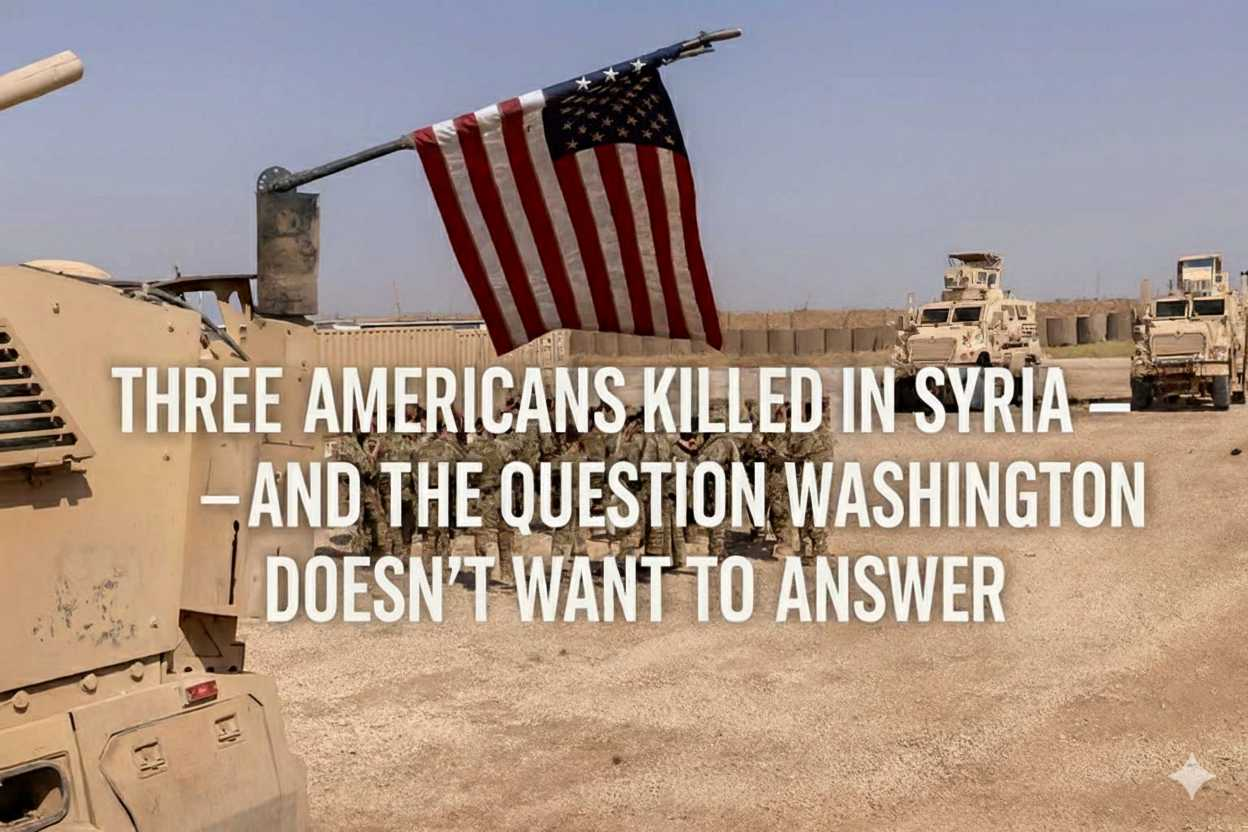
Three Americans Killed in Syria — and the Question Washington Doesn’t Want to Answer
December 13, 2025
post photo preview

Breaking news this Saturday: three Americans are dead in Syria tonight, three more are wounded, and the attack—described by U.S. Central Command as an ambush carried out by a lone ISIS gunman—has once again dragged the Syrian war back into the American consciousness for a few brief hours, which is usually all the time the public gives it before the news cycle moves on and the families are left to carry the weight alone.
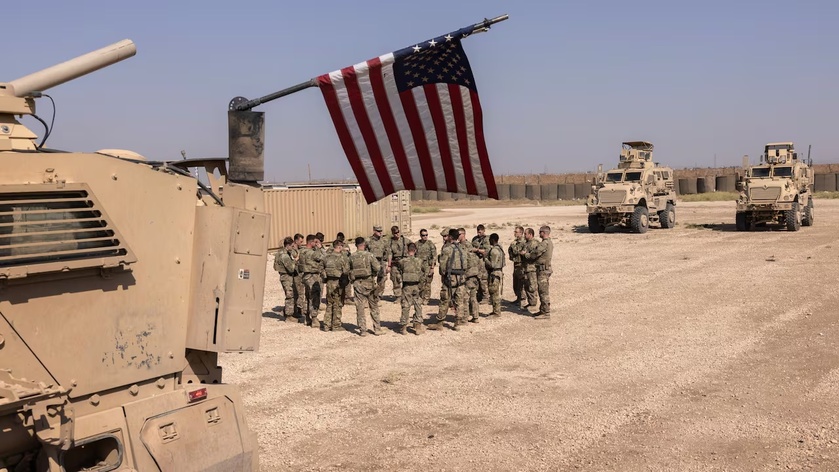
 

CENTCOM says two of the dead were U.S. service members and one was an American civilian contractor, and that the attacker was engaged and killed as well, with names being withheld until next of kin are notified, which is the right thing to do; but even with those official facts in hand, I want to slow the pace down a little bit and do what I always try to do here—put this in context—because in a place like Syria, the story you get in the headline is almost never the story that explains why this happened.

I’m not interested in reporting tragedy like it’s a scoreboard, and I’m not interested in repeating a paragraph of breaking news without the background that makes it intelligible; I spent eight years in the military, and I’ve spent more than twenty years following the U.S. military across the globe—Afghanistan, Iraq, and Syria included, with more than a dozen trips into Afghanistan, roughly fifteen into Iraq, and seven or so into Syria—so when Americans die in a place most people couldn’t find on a map, I feel a responsibility to show you what the map actually means.

The desert isn’t empty—ISIS hides in the “nothing”

The reported location of the attack is Palmyra—Palmira on some maps—an ancient city in central Syria that sits on the edge of a brutal expanse of desert, the kind of wide open, sun-blasted country where outsiders assume nothing lives and nothing happens, when in reality it’s exactly the kind of terrain insurgents love because “nothing” is a perfect disguise, a perfect place to move, cache weapons, blend into small villages, disappear into wadis, and wait for opportunities.

Palmyra also sits inside territory controlled by Syria’s new administration under Ahmed al-Sharaa, and if that name makes you pause, it should, because this is where Syrian politics gets complicated in the way only Syria can do: al-Sharaa rose through jihadist ranks, he has a history tied to insurgent warfare against Americans in Iraq, he was captured and held for years, and he later returned to Syria and consolidated power with strong Turkish backing—so when you hear phrases like “new Syrian administration” or “transitional government,” don’t imagine a Western-style democracy that suddenly appeared out of the sand; imagine a patchwork of militias, alliances of convenience, old enemies wearing new uniforms, and a leadership class that wants international legitimacy while carrying a past that cannot be scrubbed clean with a new suit and a new flag.

Now layer on top of that the reality that ISIS is not gone from Syria, not even close.

U.S. estimates have long suggested there are still roughly 2,000 to 3,000 ISIS fighters operating in and around the central Syrian desert, and there are far more than that if you include facilitators, family networks, financiers, and the enormous number of ISIS-linked detainees and relatives held in camps and makeshift prisons; and while that fight has mostly slipped out of the American public’s view, it continues quietly, relentlessly, week after week, because the moment pressure is relieved in a place like this, the violence doesn’t fade—it regroups.

Why American troops are still there—despite everything

The United States currently has about 900 troops in Syria, a number that matters because it tells you how thin the margin is between “containment” and “collapse,” especially when the enemy has deep local roots and decades of practice living off the land and off the grievances of the people around them; and those American troops are there for one primary purpose: to keep a lid on ISIS so we don’t wake up one day to another wave of mass executions, terror-state governance, and regional destabilization that forces the world back into a far more expensive war.

That’s the mission, and it’s not abstract; when ISIS surged the last time, the human cost was staggering, and it wasn’t paid by politicians or pundits—it was paid by Iraqi soldiers, Kurdish fighters, civilians, and yes, Americans too—and the reason our presence in Syria still functions as a deterrent is that in a powder keg region, a small, capable American footprint has a way of discouraging ambitious actors from taking the final step that turns instability into open war.

But here is the part that doesn’t get said out loud very often: the mission in Syria is increasingly tangled up in partnerships that are, at best, uneasy and, at worst, morally and strategically risky.


Only for Supporters
To read the rest of this article and access other paid content, you must be a supporter
12
What else you may like…
Videos
Podcasts
Posts
Articles
Bringing dignity to imprisoned women

I’m in Cartagena and yesterday we went to the women’s prison here to bring some much-needed necessities to the ladies and give them the gospel of the good news of Jesus Christ. It was a powerful time. I’m very glad I got a chance to do this. Thank you to all of you who donated to help these women. They are truly “the least of these “.

00:00:19
Day 2 Syria
00:01:36
Disney Land for Men in Iraq.
00:00:57
Episode 622 - Field Producer Dennis Azato and Chuck Reminisce

My erstwhile field producer and cameraman Dennis Azato has accompanied me on ten years of adventures across the globe. Today he joins me in Ukraine and we spend some time remembering our many trips together.

Episode 622 - Field Producer Dennis Azato and Chuck Reminisce
Calling Young Men to Lead: Join The Forge This Summer

We’re launching our very first Forge Field Leadership Camp this summer!

The Forge is a one-week, field-based camp for young men (ages 13–17), built on a biblical foundation. It’s designed to train real-world skills—navigation, survival, building, leadership—while shaping character, discipline, and faith.

This is more than a summer camp. It’s a call to rise.

Led by veterans and experienced mentors, these young men will be challenged to grow stronger in every way—physically, mentally, and spiritually.

Dates: August 2–9
Ages: 13–17
Apply now: https://www.frontierforge.org/

post photo preview
A New Milestone!
post photo preview
Car Explosion Outside U.S. Embassy in Yerevan Sparks Fire, Investigation Underway

YEREVAN, Armenia — February 19, 2026
A vehicle exploded outside the U.S. Embassy in Yerevan, Armenia, this evening, prompting a significant fire and emergency response from local authorities, according to multiple eyewitness reports and local media.

Around 6:00 p.m. local time, a car reportedly exploded on Isakov Avenue, directly in front of the U.S. Embassy compound in Armenia’s capital. The blast was powerful enough to ignite a large fire that was visible from surrounding blocks and drew firefighters and police to the scene.
Video posted on social media shows flames and smoke rising from the area of the explosion, and emergency services were at the location within minutes.

At this time, no official statement has been released by the U.S. Embassy or Armenian government regarding the cause of the explosion, possible casualties, or whether the incident was deliberate. Authorities are currently investigating.
Embassies typically have robust security perimeters, and there is no confirmed...

post photo preview
Live Call TOMORROW
Our live call is this Saturday, February 21st at 12:00 PM Eastern.

Local’s members,

Our live call is this Saturday, February 21st at 12:00 PM Eastern.

Chuck just returned from Colombia and Syria and will be taking your questions—covering everything from ministry work on the ground in Colombia to the evolving geopolitical situation overseas. This is your chance to go deeper and hear directly from him.

He’ll also be sharing more about the upcoming Frontier Forge Institute summer camp, including its mission to train young men (ages 13–17) in Christian leadership, discipline, and responsibility. 

Only for Supporters
To read the rest of this article and access other paid content, you must be a supporter
Read full Article
post photo preview
Mercy on the Ground, War on the Horizon

The conflict between the United States and Iran is doing that strange dance right now. On one hand, you’ve got “negotiations” in Geneva. On the other hand… you’ve got aircraft carriers moving.

Axios reported this morning that we may be closer to striking Iran than most people realize. Not months. Not “someday.” Possibly days. And if you watch the hardware, it tells a clearer story than the press releases.

In just the last 48 hours, reports indicate the U.S. has surged:

  • 48 F-16s

  • 12 F-22s

  • 18 F-35s

  • 6 E-3G Sentry AWACS aircraft

  • Roughly 40 aerial refueling tankers

Meanwhile, the USS Gerald R. Ford carrier strike group has passed the Rock of Gibraltar and entered the Mediterranean.

And here’s what most people don’t understand:

That carrier does not have to sail into the Strait of Hormuz to be useful.

From the eastern Mediterranean—especially with tanker support—U.S. aircraft can strike targets inside Iran. Which means this could kick off before the Ford ever gets to the Gulf.

These “Talks” Aren’t Really Talks

The negotiations happening in Geneva aren’t face-to-face. There’s no American official sitting across a table from the Ayatollah. It’s shuttle diplomacy.

Omani intermediaries walk between rooms—one room with American envoys, another with Iranian representatives—carrying messages back and forth.

The U.S. says:
“You must give up highly enriched uranium and abandon your nuclear ambitions.”

Iran says:
“We’re willing to talk.”

And then quietly:
“Just not about that.”

That’s not negotiation.

And while the delay continues, the Ayatollah is publicly threatening to sink American carriers, calling them “big targets.”

Can Iran Sink a Carrier?

Let’s be serious for a moment. Yes, Iran has hypersonic missiles. Yes, they have thousands of short-range missiles designed to threaten neighbors like Saudi Arabia. Yes, they have speedboats with guns and some small submarines.

But here’s the problem for them:

Only for Supporters
To read the rest of this article and access other paid content, you must be a supporter
Read full Article
Iran’s Threat Videos, America’s Buildup, and the Question Nobody Wants to Answer

Right now, the nuclear talks in Geneva are stalling with Iran. Meanwhile, the United States is building combat power in the region at a level we haven’t seen since the Iraq invasion—two aircraft carriers, dozens of warships, hundreds of combat aircraft, and tens of thousands of troops either in theater or moving that direction.


The U.S. buildup is not subtle—and Iran knows it

From what I’m tracking, the U.S. is moving into the region with:

  • Two carrier strike groups (one already in theater and another inbound)

  • 300–400 combat jets in the region when you count land-based aircraft

  • Patriot and THAAD batteries shifting into place

  • Aegis destroyers tuned for ballistic missile defense

  • A steady stream of support aircraft—tankers, ISR platforms, and the stuff you don’t talk about on a public livestream

And here’s the point: the United States isn’t putting all that out there to “negotiate harder.” That’s the kind of posture you take when you want your opponent to understand the consequences before you act.

Iran’s information war just leveled up (and yes, the video was impressive)

Iran has been pumping out threat videos for weeks—straight of Hormuz posturing, military drills, the whole production.

But they dropped one recently that honestly looks like a Super Bowl ad for ballistic missiles.

And I’ll say this plainly: it was well-made. Whoever is building their media operation understands modern influence warfare. The goal isn’t just to scare Israel—it’s to scare Americans, spook markets, pressure allies, and make decision-makers hesitate.

The missile they’re showcasing is the Khoramshahr-4 (they’re pitching it as unstoppable, “uninterceptable,” and essentially a war-ending weapon).

So let’s talk about what it can do—and what it can’t.

Khoramshahr-4: a serious threat, but not a war-winner

From the way this missile is being described, it’s a liquid-fueled, medium-range system with roughly 2,000 km range—meaning Israel is in reach, U.S. bases in the region are in reach, and potentially some assets farther out are threatened depending on basing and launch options.

The real concern isn’t just speed. The concern is maneuverability on re-entry—a re-entry vehicle that can adjust course makes interception harder.

But here’s the part that matters strategically:

  • A weapon can be terrifying and still not be decisive.

  • A missile can get through sometimes and still not win the war.

Even if Iran had a significant number of these—and even if a percentage penetrated defenses—that’s not enough to defeat the combined combat power the U.S. and Israel can bring to bear.

Iran can cause damage. Iran can kill people. Iran can make the cost real.

But Iran cannot win a conventional war against the U.S. and Israel.

That’s why they’re leaning so heavily into the psychological side: if you can’t win the fight, you try to prevent the fight.

The Strait of Hormuz threat has a problem: China

Only for Supporters
To read the rest of this article and access other paid content, you must be a supporter
Read full Article
See More
Available on mobile and TV devices
google store google store app store app store
google store google store app tv store app tv store amazon store amazon store roku store roku store
Powered by Locals