








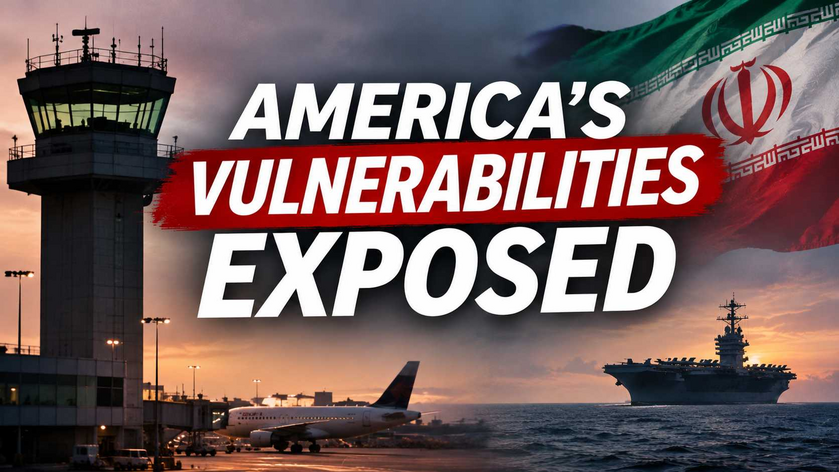
An unprecedented aviation shutdown, reports of Iranian threats against President Trump, and renewed attacks in the Persian Gulf are raising serious questions about American security and preparedness.
A nationwide aviation shutdown, reports of an Iranian assassination plot against President Donald Trump, and continued military threats in the Persian Gulf have exposed some troubling vulnerabilities in America's national security. Although these developments appear to be unrelated, they illustrate how quickly modern systems can be disrupted and how dangerous it is to assume that the government can protect the country from every conceivable threat.
During my latest Hot Zone broadcast, I examined what officials are saying about the Federal Aviation Administration's massive system failure, new intelligence reports involving Iran, and the increasingly uncertain prospects for resolving the conflict in the Middle East. What concerns me most is not simply that these events occurred, but how much they reveal about the condition of America's critical infrastructure and the challenges facing our military leadership.
An Aging Aviation System Finally Breaks Down
The nationwide ground stop that disrupted American air travel on Friday initially prompted speculation about terrorism or a foreign cyberattack. Given the growing number of threats against American infrastructure, those concerns were understandable, but the evidence presented so far points toward a considerably more ordinary explanation.
Transportation Secretary Sean Duffy explained that the disruption apparently began during routine maintenance at a remote FAA facility, where contractor L3Harris was transitioning telecommunications equipment from aging copper connections to fiber-optic technology. During that process, a router reportedly began overwhelming other components of the network with more than 1,000 connection attempts every four to five seconds, interfering with communications and radar information.
The FAA responded by grounding aircraft until technicians could isolate the problem and restore the system. Officials said they had not determined whether the failure resulted from contractor error or defective equipment, although they did not believe a cyberattack was responsible.
What astonishes me is the age of the technology involved. According to information discussed during the broadcast, some equipment dates back to 2001, while portions of the underlying air traffic control infrastructure are considerably older.
I flew more than 300,000 miles last year, and I expect to travel a comparable distance this year. Knowing that one of the world's most technologically advanced countries continues depending on equipment that is decades old to manage its airspace is hardly reassuring.
The shutdown reportedly disrupted thousands of flights and affected more than a million travelers, with delays continuing long after the system was restored. Although officials deserve credit for prioritizing passenger safety, the incident demonstrates how a relatively localized technical failure can produce nationwide consequences.
The administration has emphasized the need for additional funding to modernize air traffic control. However, Congress has already provided substantial resources for FAA improvements, and the public deserves a clear explanation of how those funds are being spent and why critical systems remain so vulnerable.
Preparedness Is Not the Same as Panic
The aviation failure also renewed questions about reports that American military installations have been instructed to maintain significant emergency supplies, including food, water and fuel.
Homeland Security Secretary Markwayne Mullin attempted to reassure Americans during a television interview, arguing that the United States possesses stronger infrastructure and greater redundancy than many other countries. He urged the public not to interpret military preparedness measures as evidence that a national emergency was imminent.
I appreciate the effort to prevent unnecessary panic, but I disagree with the suggestion that ordinary Americans have no reason to prepare for disruptions.
There is nothing unreasonable about keeping emergency food, drinking water, essential medications and backup communications available for your family. The aviation shutdown demonstrated how quickly a technical problem can affect an enormous number of people, and an extended disruption to electricity, communications or transportation could create much more serious consequences.
I've written extensively about community preparedness in my book Death of Civilization, and one of the most important lessons is that resilience begins long before an emergency occurs. Families should know how to communicate when cellular networks fail, while neighbors should understand who might need assistance during an extended power outage.
That doesn't require living in fear or assuming that disaster is inevitable. It simply means recognizing that government systems, however sophisticated, are not infallible.
Reports of an Iranian Plot Against Trump
Meanwhile, an Israeli newspaper has reported that intelligence officials warned Washington about an alleged Iranian plan to target President Trump and other senior American officials using explosive-laden drones.
According to the account discussed during the broadcast, Israel's Mossad shared intelligence with American counterparts, and another Western intelligence service reportedly reviewed the findings. However, the alleged plot has not been publicly confirmed by the White House or the CIA, making it important to distinguish the reported warning from an established assassination attempt.
When questioned about the threat, Trump responded with humor, suggesting that the reporters standing near him would also be in danger if someone attempted to attack him.
The president's security detail has extensive counter-drone capabilities, and a successful attack against a heavily protected official would face substantial obstacles. Nevertheless, the rapid development of relatively inexpensive drone technology has created security challenges that governments can no longer afford to dismiss.
Having reported extensively from Ukraine, I have seen how small unmanned aircraft have transformed modern warfare. Systems that once required sophisticated military resources can now be produced at a fraction of the cost, forcing security services to rethink how they protect personnel and installations.
If the allegations concerning Iran are substantiated, Washington will have to consider what they mean for negotiations with a government accused of threatening the American president.
Iran's Military Threat Has Not Disappeared
The reported assassination threat comes as the United States continues maintaining a substantial naval presence near Iran.
During the broadcast, I discussed reports of three American aircraft carriers operating in the broader region, along with destroyers and other supporting vessels. Such a concentration of naval power provides Washington with considerable military options, although the presence of those forces does not necessarily mean another operation is imminent.
Iran, meanwhile, continues presenting itself as capable of resisting American pressure. Reports discussed during the broadcast suggest that Tehran may retain between 1,500 and 2,500 missiles, although the estimate was described as having low confidence.
Iranian authorities have also claimed responsibility for attacks against commercial tankers in the Strait of Hormuz and American military facilities in Bahrain. Some of those claims remain unverified, and American officials have disputed Iranian accounts of successful strikes.
One particularly dramatic Iranian claim involved the alleged sinking of a large oil tanker carrying approximately two million barrels of crude. I have not seen independent evidence establishing that such a vessel was lost, and the absence of a corresponding major reaction in maritime insurance markets raises further questions about the claim.
These distinctions matter because wartime propaganda is designed to influence public perceptions as much as military outcomes. We should take credible threats seriously without accepting every statement issued by Tehran as fact.
Economic Pressure Has Its Limits
Treasury Secretary Scott Bessent has argued that Iran's economy is deteriorating rapidly under American pressure, citing projections of a potentially severe contraction between March 2026 and March 2027.
Economic restrictions can impose enormous costs on a government, but they do not automatically produce political change. Iran's leadership has demonstrated a willingness to tolerate extraordinary hardship among its own population while continuing to prioritize military and security operations.
At the same time, global oil markets appear to be adapting to disruptions in the Persian Gulf. Increased production from other countries and substantial quantities of crude already in transit have helped ease concerns about an immediate supply crisis.
I discussed the possibility that expanding global production could eventually create an oversupply, pushing energy prices lower even while Iranian exports remain restricted. That would be welcome news for consumers, although the consequences for oil-producing countries could be considerably more complicated.
The larger question is whether economic pressure alone can persuade Iran's leadership to abandon its regional military activities and nuclear ambitions. I remain skeptical that sanctions, without a credible broader strategy, will produce the outcome Washington wants.
Washington Needs a Clear Strategy
The United States possesses overwhelming military capabilities, but military strength is only useful when political leaders establish clear and achievable objectives.
I am increasingly concerned that the administration's public statements about Iran have not always matched developments on the ground. Americans have repeatedly heard that the conflict is effectively over, yet Iranian threats continue, American forces remain deployed, and the possibility of renewed fighting has not disappeared.
That uncertainty also affects the service members assigned to ships and bases throughout the region. Maintaining a substantial military presence indefinitely without a clearly communicated mission places additional strain on personnel and equipment while leaving America's adversaries uncertain about Washington's intentions.
A lasting settlement would be preferable to another prolonged conflict, provided it genuinely addresses the threats that brought the United States and Iran into confrontation. But diplomacy must be supported by a realistic assessment of Tehran's capabilities, intentions and willingness to comply with any agreement.
The aviation shutdown offers an important parallel. America cannot solve its infrastructure problems simply by reassuring the public that everything is under control, just as it cannot resolve a military confrontation by repeatedly declaring that victory has already been achieved.
In both cases, the country needs competent leadership, honest assessments and a willingness to confront difficult realities before they develop into larger crises.
The immediate aviation emergency has passed, but the vulnerabilities it exposed remain. And while the administration continues searching for a way forward with Iran, the threats facing American personnel, infrastructure and national security have not disappeared.
We would be wise to recognize both realities rather than waiting for the next emergency to remind us how fragile some of our most important systems have become.