Chuck Holton
Politics • Culture • News
JD Vance in Armenia: What we know so far
February 10, 2026
post photo preview


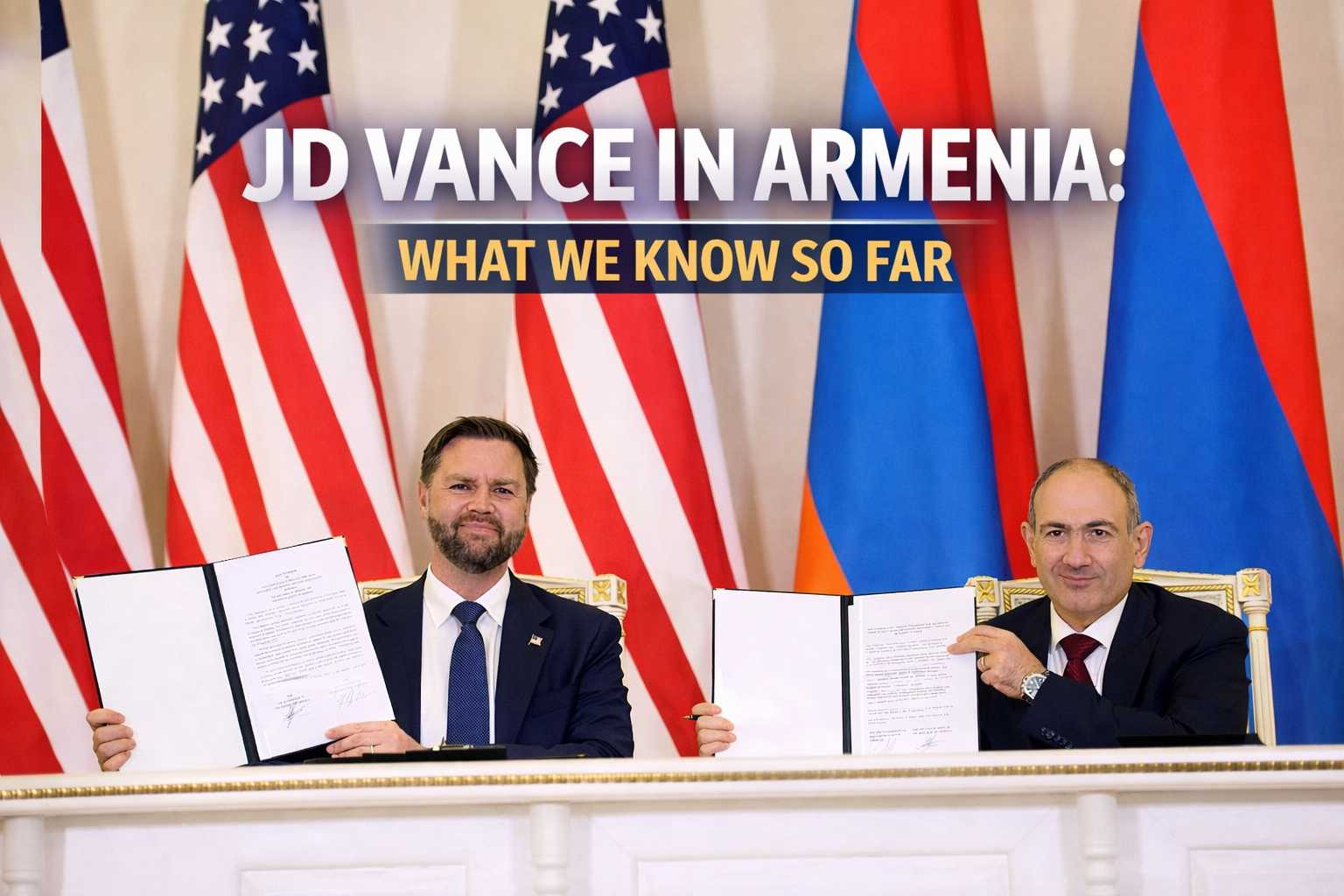
U.S. Vice President J.D. Vance’s February 9–10, 2026 trip to Yerevan marked a first in modern U.S.–Armenia relations: by multiple outlets’ reporting and by Armenia’s own official messaging, he is the first sitting U.S. vice president to visit Armenia. That “first-ever” framing matters, because the visit was not treated as ceremonial; it was structured around deliverables tied to Armenia’s post-2023 security recalibration, the U.S.-brokered Armenia–Azerbaijan track, and a set of economic and defense cooperation announcements that Armenian officials presented as strategic rather than symbolic.
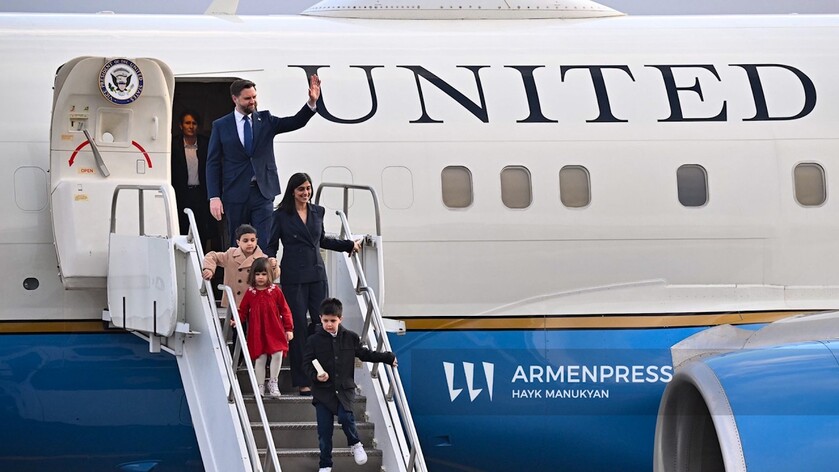
Armenian outlets reported that Vance arrived in Yerevan on February 9 accompanied by his wife, Usha Vance and with their children as well, and that he was received at Zvartnots by senior Armenian officials including National Assembly Speaker Alen Simonyan and other government figures. From there, the core of the visit centered on meetings with Prime Minister Nikol Pashinyan, followed by joint statements for the media that emphasized “institutionalizing peace” and expanding the bilateral “strategic partnership.”

On February 10, Vance and his wife visited the Tsitsernakaberd Armenian Genocide Memorial complex, laid flowers at the eternal flame, and signed the Book of Honored Guests—an appearance covered prominently by Armenian press. Armenian reporting also noted heightened security around the memorial during the visit, underscoring how closely watched the optics were domestically.


The headline deliverable: civil nuclear cooperation and the “123 Agreement” track

The most consequential announcement was a bilateral statement indicating that Armenia and the United States had completed negotiations on what is widely referred to as a “123 Agreement”—the legal framework required for U.S. civil nuclear cooperation and licensing of nuclear technology exports. Reuters characterized this as a major step that could enable U.S. participation in Armenia’s plan to replace the aging Metsamor nuclear plant, with Vance publicly attaching large export figures to the prospective cooperation (reported as up to $5 billion initially, plus additional longer-term fuel and maintenance arrangements).
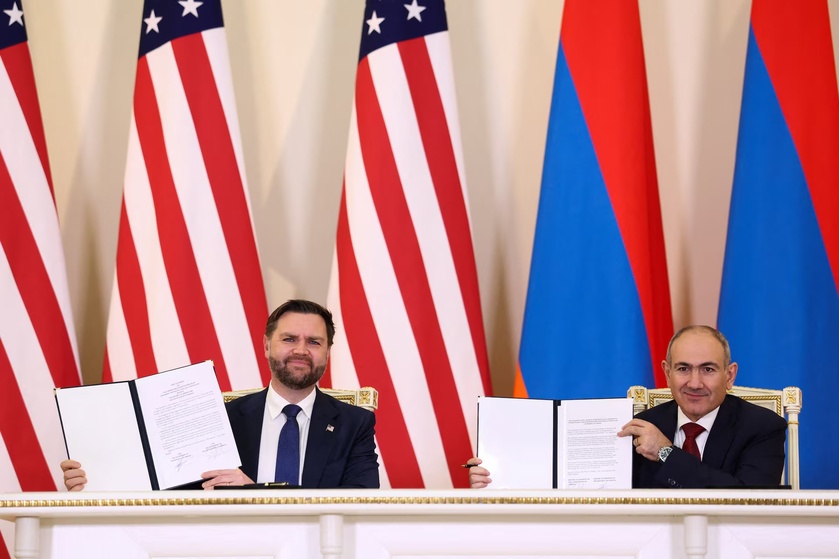
Why this matters in Armenian terms is straightforward: energy security is strategic, and Metsamor replacement planning has long been entangled with geopolitics. Reuters explicitly framed the move as part of Armenia’s effort to reduce dependence on Russian and Iranian energy links and as a potential blow to Moscow’s traditional role in the sector—an interpretation reinforced by Russian officials’ public pushback and promotion of Rosatom as an alternative.

That said, Armenian and regional reporting also highlighted ambiguity around some of the figures and framing used during the visit—particularly the scale and timing of the “export” numbers—suggesting that some of what was presented as a near-term “deal” is better understood as a negotiated framework and political commitment that still requires follow-through, project selection, and financing decisions.

Defense and technology: a drone sale framed as a precedent

A second major headline out of Yerevan was Vance’s announcement of a U.S. sale of drone and surveillance technology to Armenia, reported as worth $11 million and described as a significant milestone in U.S.–Armenia defense cooperation. The drone component is represented as a “first-ever major” U.S. military-technology sale to Armenia, pairing it with broader claims about advanced technology exports and investment intent.
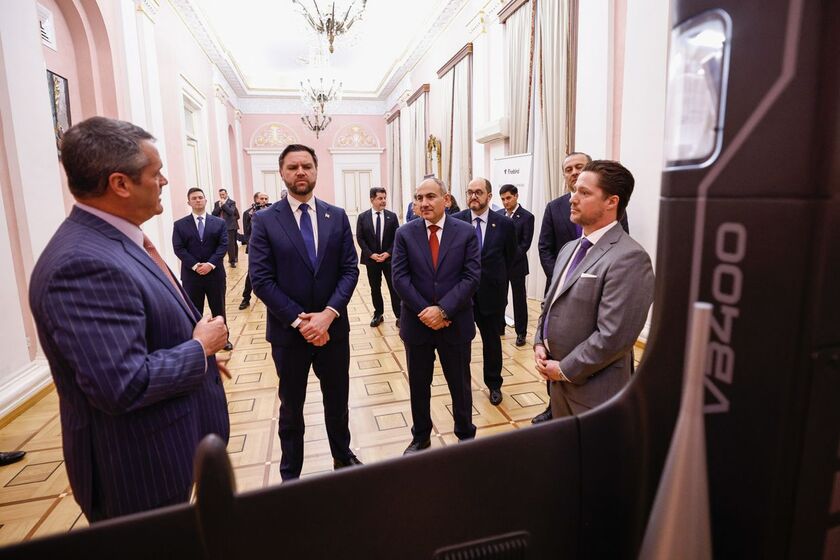
For Armenian audiences, the significance is less about the dollar value than the precedent: it signals a willingness—at least at the level of public political messaging—to deepen practical defense ties at a time when Armenia has been diversifying suppliers and partnerships.

TRIPP and the peace/economics linkage: what the U.S. is trying to lock in

Only for Supporters
To read the rest of this article and access other paid content, you must be a supporter
6
What else you may like…
Videos
Podcasts
Posts
Articles
Live Call Recording: April 25, 2026

Thank you all for joining us this month on our Live call. I love getting to see your faces and have real conversations with you all.

What was your favorite moment or topic from this call?

01:25:31
Israel Makes a Commercial from its Critics

Love this.

00:00:49
Pahlavi Speaks Out Against Leftist Journalists

The Prince hits back at the spectacularly one-sided coverage the war is getting in Europe. Powerful stuff.

00:04:24
Episode 622 - Field Producer Dennis Azato and Chuck Reminisce

My erstwhile field producer and cameraman Dennis Azato has accompanied me on ten years of adventures across the globe. Today he joins me in Ukraine and we spend some time remembering our many trips together.

Episode 622 - Field Producer Dennis Azato and Chuck Reminisce

Victor Marx is on Fox News right now….

In my flesh, I'm introverted and anti-social, but in Christ, I am created for connection, as is every other child of God. Let us not then embrace worldly definitions (like I'm an introvert), and allow them to dictate our life courses, but rather the truth of Scripture and His very Spirit. For as God's workmanship (Ephesians 2:10), we are being renewed in His image (Colossians 3:10), and so, like Him, we are relational creatures, made to uniquely connect with and love both God and people. And only when we consecrate our lives to this holy purpose, can we begin to spiritually flourish in Christ Jesus.

Chuck Talks About His New Book
post photo preview
The Illusion of Control in a War That’s Anything But Controlled

When you spend enough time around conflict—real conflict, not the sanitized version filtered through headlines—you begin to recognize a pattern that most people miss.

At the beginning of almost every war, there is a moment when one side appears to be in control. The strikes are precise, the objectives are clear, and the narrative is simple enough for public consumption. It looks organized. It looks deliberate. It looks like someone, somewhere, has a plan. But that moment never lasts. And what we are seeing right now is the beginning of that shift.

What Looks Stable… Usually Isn’t

From a distance, the situation appears manageable. Military assets are being deployed with precision, targets are being hit, and responses are being measured—at least on the surface. But stability in war is often an illusion. Because what you’re really looking at is not control—it’s timing. Timing between actions. Timing between responses. Timing between decisions that haven’t yet been made. And once that timing breaks down, everything changes. That’s when a conflict stops being predictable and starts becoming dangerous in ways that no one can fully control.

The Problem With Modern Warfare

One of the biggest misconceptions people have about modern conflict is that technological superiority guarantees a clean outcome. It doesn’t. What it does is create the appearance of control. Precision weapons, intelligence gathering, satellite surveillance—all of these tools allow a military to operate with incredible effectiveness in the early stages. But they do not eliminate uncertainty. In many ways, they simply push it further down the timeline. Because war is not just about destroying targets. It’s about influencing behavior. And behavior is far harder to predict than infrastructure.

Only for Supporters
To read the rest of this article and access other paid content, you must be a supporter
Read full Article
post photo preview
This War Isn’t Slowing Down—And That Changes Everything

In a recent briefing, President Donald Trump made something unmistakably clear: this war is not operating on a timeline, and it is not approaching a natural pause. Instead, it is accelerating in both scope and intensity, moving beyond limited strikes into a sustained campaign that is beginning to reshape the strategic landscape of the Middle East in real time.

That reality alone should force a reassessment of how this conflict is being understood, because what may have initially appeared to be a short, decisive military operation is now evolving into something far more complex, with consequences that extend well beyond the immediate battlefield.

From Targeted Strikes to Sustained Pressure

The early phase of the war was defined by overwhelming force, as the United States and its allies executed a series of large-scale precision strikes against Iranian military infrastructure. Thousands of targets were hit, including missile systems, naval assets, and weapons production facilities, resulting in the significant degradation of Iran’s conventional military capabilities.

In addition to the air campaign, the United States implemented a sweeping naval blockade designed to isolate Iran economically and militarily, effectively placing the entirety of its coastline under surveillance and control.

At first glance, these actions created the impression of a decisive and controlled campaign, one in which the outcome seemed largely predetermined by the imbalance of military power.

But wars are rarely decided in their opening phase.

A War That Has Moved to the Sea

What has emerged more recently—and what the latest developments highlight—is a shift toward a more dangerous and unpredictable phase centered on maritime conflict.

The Strait of Hormuz, one of the most strategically critical waterways in the world, has become a focal point of confrontation, with Iranian forces targeting commercial vessels and attempting to disrupt global shipping lanes. In response, the United States has escalated its posture, ordering naval forces to take direct and lethal action against Iranian boats engaged in mine-laying operations.

This directive represents more than a tactical adjustment; it signals a transition into a more aggressive and persistent form of engagement, one that increases the likelihood of miscalculation and rapid escalation.

The presence of multiple U.S. warships, aircraft, and mine-clearing operations in the region underscores the seriousness of the situation, as does the growing number of incidents involving attacks on commercial shipping.

What is unfolding in the Strait is not a sideshow—it is a central front in a conflict that now directly impacts global trade and energy markets.

Why Dominance Does Not Equal Resolution

Despite the clear military advantage held by the United States, there are signs that the conflict is entering a phase where superiority alone may not be enough to achieve a decisive outcome.

Iran’s naval capabilities have been severely degraded, and a large portion of its military infrastructure has been damaged or destroyed.

And yet, the continued ability of Iranian forces to disrupt shipping, deploy mines, and conduct asymmetric attacks reveals a deeper truth about modern warfare: even a weakened adversary can remain dangerous when it adapts its strategy.

This is particularly evident in the use of small, fast-attack boats and decentralized tactics, which allow Iran to operate in ways that are difficult to fully counter through conventional means.

In other words, the battlefield has shifted from one of direct confrontation to one of persistent disruption.

The Strategic Stakes Are Global

Only for Supporters
To read the rest of this article and access other paid content, you must be a supporter
Read full Article
Live Call With Chuck Link
What Do YOU Want To Ask Chuck?

Tomorrow at 12:00 PM New York time, we are going live with Chuck for our supporter call.

So let me ask you this… what do YOU want to ask Chuck? What’s been on your mind after these last few episodes? What do you want clarity on? What are you not hearing answered anywhere else?

Drop your questions in the comments here or go back to the original post and add them there.

We’re going through all of them and pulling the best ones for the call. Don’t hold back; we can talk openly in these calls. 


Join the call here: https://meet.google.com/iqr-tope-rqz

Read full Article
See More
Available on mobile and TV devices
google store google store app store app store
google store google store app tv store app tv store amazon store amazon store roku store roku store
Powered by Locals